A video underperforms and the instinct is to blame the content. Wrong topic, wrong timing, wrong niche. So a completely different video gets made with a new topic, new approach, more effort and the same retention pattern shows up again.
Video hooks carry more weight than most creators give them credit for. The same content can produce dramatically different retention curves depending entirely on how the first two seconds look and feel. Changing the opening, not the content, changes how many people actually watch.
Testing video hooks is how creators stop guessing about this. Instead of publishing one version and hoping it lands, a testing approach creates multiple opening variations from the same core content and compares what the data shows. The content stays identical. The hook transition changes. The retention difference between versions reveals which opening style actually works for a specific audience.

This isn’t complicated to do. It requires a simple process, a basic tracking system, and patience with the data. Over time, it produces something more valuable than any single viral video: a library of proven opening styles that work reliably for a specific creator’s specific audience.
Why One Video Can Perform Differently With Different Hooks
What happens in the first two seconds does something beyond stopping the scroll. It tells the viewer what kind of video they’re about to watch the pace, the stakes, the energy level. That signal shapes how they experience everything after it. A viewer who got a strong curiosity signal at the opening is leaning forward by the time the actual content begins. A viewer who got a static, low-energy opening is already halfway out even if they technically kept watching. A weak opening loses viewers before the content has delivered anything worth evaluating.
The relationship between the first few seconds and overall retention is direct and visible in the data. Look at two retention graphs side by side, one that drops steeply in the first few seconds and one that holds relatively flat through the opening. The video with the flat opening almost always shows better completion numbers through the rest of the runtime, even when the content after the opening is essentially the same. The opening graph shape predicts the rest of the curve more reliably than anything in the middle section does. Lose people at the start and the content never gets a fair audience to retain.
Curiosity is specifically what drives this forward pull. When an opening creates a question the viewer needs answered through a visual, a statement, an implied result the viewer’s attention commits to finding that answer. Content that delivers on curiosity keeps them through completion. The hook earns the watch time. The content justifies it.
Here’s a practical example. A business creator makes a video about a common pricing mistake. Version one opens on a static talking head: “I want to talk about a pricing mistake a lot of people make.” Version two opens on a fast zoom to a screenshot of lost revenue with no caption, then cuts to the creator mid-sentence: “…and I didn’t realize it was costing me clients.” Same content after the first five seconds. Completely different viewer experience in the opening. The retention curves often look like they came from different videos.

Separating content quality from hook performance is what testing makes possible. Without testing, a creator never knows whether a video underperformed because the content was weak or because the opening didn’t earn enough attention for the content to get seen.
What Should You Test in a Video Hook?
Not everything in a hook transition is worth testing independently. The first frame visual is the highest-leverage variable. Whatever appears at frame zero determines whether the viewer’s eye tracks the video or continues scrolling. A static talking head at frame one versus a fast zoom or a surprising visual at frame one can produce significantly different early retention outcomes for otherwise identical content.
The opening statement is the second major variable. The same visual with different spoken content: a direct statement versus a curiosity gap, a claim versus a question, a result versus a setup changes the viewer’s forward pull without changing anything visual.
Hook clip versus no hook clip is a clean test for creators who haven’t yet introduced pre-roll transitional hooks into their workflow. Running the same content with a two-second transitional hook at the opening versus starting directly on the creator shows whether the transition hook clip adds value for that specific audience and content type.
Caption wording in the first two seconds is a testable variable that affects muted-autoplay viewers specifically. The same visual with different text overlay wording can produce different tap-to-unmute behavior, which affects how many viewers get past the muted opening into the audio content.

Pattern interrupt intensity is worth testing across content types. A heavy pattern interrupt fast smash cut, color shift, dramatic zoom versus a subtle one clean cut, slight push-in produces different results for different audiences. Educational audiences sometimes respond better to controlled openers. Entertainment audiences often need higher intensity.
The guiding rule: change one major variable at a time when possible. Two versions that differ by one element produce data about that element. Two versions that differ by five elements produce data about nothing useful.
How to Create Multiple Hook Versions From One Video
- A finished video is already most of the work. Creating multiple hook versions from one piece of content requires only reediting the first five seconds, not the whole video.
- A direct hook opens by stating the video’s value proposition immediately. No buildup, no preamble. “This pricing mistake costs most freelancers at least one client a month.” The viewer knows exactly what they’re getting and either wants it or doesn’t.
- A curiosity hook withholds the explanation while implying the stakes. The same video opens on a screenshot of a client conversation partial, unreadable and cuts to the creator mid-thought: “…so I had to figure out why this kept happening.” The viewer needs to know what happened.
- A transitional hook places a downloaded hook clip before the main content. A fast zoom, a whip pan, a pattern interrupt visual one to two seconds of movement that catches attention before the creator appears or the content begins. The same main video, different first impression.
- A question hook inverts the structure. Instead of stating the point, the opening asks something the viewer has probably wondered. “Why do some freelancers consistently win clients that seem out of their league?” The answer is in the content. The question creates the pull.
- A result-first hook shows the outcome before the explanation. The creator shows the result as a metric, a transformation, an outcome at frame one, then the content explains how it happened. Same information in a different sequence.
- A UGC reaction hook places an authentic, phone-camera opener before the main content. A creator reacting to something relevant, speaking directly to the lens in a real environment before the main structured content begins. Same message, different authenticity signal at the opening.
- Each of these is a different hook version of the same video. Creating all six might take an hour total. Testing them produces data that improves every future video in the same content category.
How to Measure Which Hook Performs Best
Two numbers matter most for hook evaluation: early retention and average watch time. Early retention, specifically what percentage of viewers are still watching at the two, five, and ten-second marks shows whether the hook created enough pull to get the viewer into the content. A steep drop in the first two seconds is a hook failure. A gradual decline starting at second ten is a content pacing issue. These are different problems with different solutions, and the data tells them apart.
Average watch time shows whether the hook’s pull extended through the video. A hook transition that holds viewers for five seconds but produces poor average watch time suggests the opening created curiosity that the content didn’t satisfy. The hook worked; the content didn’t follow through.
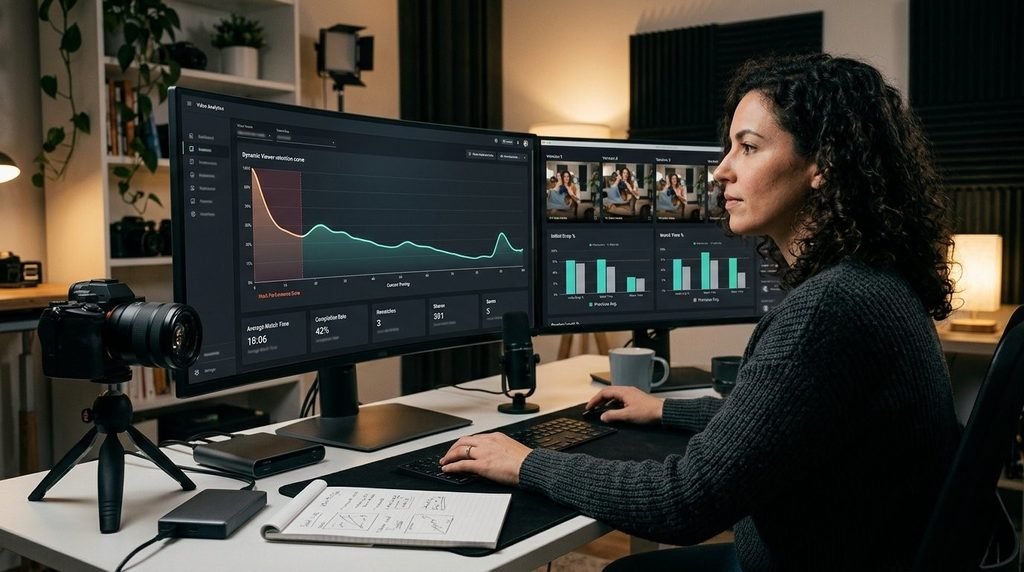
The completion rate and what percentage of viewers finished the video combines both factors. A video with strong early retention and high completion rate has a hook that worked and content that justified it. That’s the combination worth documenting and replicating.
Rewatch behavior is a secondary signal worth tracking. When viewers replay a video, the platform registers that as strong engagement. A hook that creates a loop effect where the ending connects naturally back to the beginning drives rewatch behavior that improves distribution signals.
Shares and saves provide qualitative signals about whether the content resonated beyond initial viewing. A hook that produces strong retention but no shares or saves might be stopping the scroll without creating genuine value. A transition hook that produces moderate retention but strong saves suggests the content landed with the right audience even if it didn’t reach as many people.
Compare hook versions against each other and against the creator’s existing baseline rather than against platform averages. Every account has different audience behavior, different niche dynamics, different posting frequency effects. The only meaningful comparison is within the same creator’s own content history.
Common Hook Testing Mistakes
Testing too many variables at once is the most common mistake. Changing the hook clip, the opening statement, the caption, and the music between two versions produces data that can’t be interpreted. One variable, one test. The patience required for clean testing produces far more useful information than rapid untargeted experimentation.
Pulling the analytics two hours after posting and drawing conclusions from them is a habit worth breaking. The video hasn’t reached enough viewers yet for the numbers to tell you anything reliable. A retention curve built from forty views looks nothing like the same curve at four hundred views and both might look different again at four thousand. Give it at least two full days before comparing versions. Some videos keep building distribution for longer than that. Reading the data too early doesn’t just give wrong answers. It gives confident wrong answers, which is worse.
Changing the entire video instead of the opening defeats the purpose of hook testing. If the content changes along with the hook, there’s no way to know whether the performance difference came from the hook or the content. Keep the main content identical across hook versions.
Copying another creator’s winning hook without understanding why it worked for them produces inconsistent results. A hook that performs well for a creator with an established warm audience, a specific visual aesthetic, and a well-matched content style might fail completely in a different context. The transition hook isn’t the only variable in a successful video.
Failing to record test results means repeating the same tests indefinitely. Without documentation, a creator can’t build on what they’ve learned. A simple spreadsheet tracking hook type, content category, platform, and performance notes is enough to prevent this.

Choosing a hook based only on views rather than retention metrics is a mistake specific to short-form platforms where views can reflect broad distribution rather than strong performance. A video with high views and poor retention isn’t a successful hook, it’s a successful distribution event with a weak opening. Retention is the hook metric; views are the distribution metric.
Build a Simple Hook Testing System
A tracking document doesn’t need to be elaborate. A spreadsheet with consistent columns produces the data that matters. Track each hook test with: hook type, content category, platform, posting date, two-second retention, five-second retention, average watch time, completion rate, and a performance rating. Add a notes column for observations that numbers don’t capture whether the hook felt tonally matched, whether the content delivered on what the opening implied, whether the audience seemed to engage differently in the comments.
Create a naming convention for hook versions so they’re easy to find and compare later. “ProductVideo-CuriosityHook-TikTok-March” is more useful than “Video 47 Version B” when reviewing six months of data.
Tag winning hooks clearly. A hook type that consistently produces better early retention across multiple content categories is worth flagging as a proven format. That format becomes a default starting point for new content in the same category.
Tag failed hooks equally clearly. A hook style that consistently produces steep early drop-off across multiple tests has told you something useful. Don’t reuse it as a default without understanding why it underperformed.
Create editing templates from winning hook combinations. A template in CapCut or Premiere that has a proven transition hook clip pre-positioned, a proven transition pre-timed, and a text overlay layer ready for new copy reduces the production time for the next video in the same category.
Here You Can Find Everything
HookTransiition.com provides downloadable transitional hooks and hook video clips organized by hook type and built for short-form vertical content. For creators building a hook testing library, having pre-organized assets to pull from reduces sourcing time and increases testing frequency which is ultimately what produces the data that improves performance over time.
No single hook style works universally. Every niche, every audience, every content format has its own patterns of what stops scrolls and what doesn’t and those patterns only become visible through testing.
There’s no single hook that works for everything. Spend enough time testing and that becomes obvious what holds a finance audience through the first five seconds completely fails for a beauty audience watching the same creator switch content categories. What works on TikTok lands differently on Reels. What worked three months ago might have become too familiar to interrupt anything now.Each test adds to that collection. Each documented result makes the next hook decision faster and better-grounded than guessing.
Treat every published video as a data point. Track what worked. Understand what didn’t. The creators with the strongest retention curves aren’t necessarily the most talented; they’re the ones who tested the most and paid attention to what the data told them.


