Downloaded a pack of hook clips once that looked genuinely impressive. Clean footage, dramatic visuals, the kind of stuff that looks great in a preview window. Dropped them onto the front of several videos across different accounts. Retention graphs looked exactly the same as before.The clips weren’t bad. They just weren’t doing the specific job a hook clip is suppose to do: interrupt a passive scroll in under two seconds for someone who has no prior relationship with the content or the creator.
That distinction is where most creators go wrong. A hook clip isn’t chosen because it looks good in isolation. It’s choose because of what it does to a viewer in the first second before language processes, before category evaluation, before any conscious decision about whether to stay. Visual quality has almost nothing to do with that. Psychology, motion, and timing have everything to do with it.
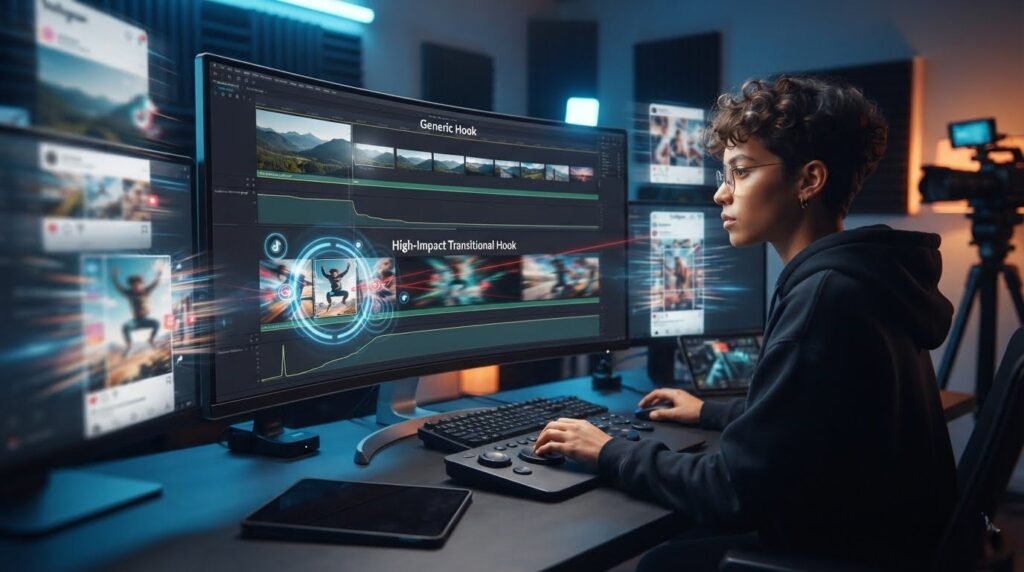
Most searches for hook video clips free or pay lead to the same problem: libraries full of footage that was built for something other than stopping a scroll. Understanding why certain clips work and most don’t change every download decision going forward.
Why Some Hook Clips Stop the Scroll While Others Get Ignored
The first second of a video is processed differently than everything after it. The viewer isn’t evaluating content yet they’re running a fast, mostly unconscious check on whether the visual warrants a pause. That check happens through a few specific mechanisms, and hook clips that don’t trigger at least one of them get scroll past regardless of how polished they look.
Pattern interruption is the most reliable mechanism. Scrolling is habitual; the thumb moves automatically through familiar-looking content. A clip that breaks the visual pattern of everything around it forces a pause before any decision to pause has made. This isn’t about being weird or jarring for its own sake. It’s about being visually different enough from the surrounding feed that the eye has to stop and process.
Curiosity gaps work alongside pattern interruption. A clip that implies something without showing it fully, a reaction without its cause, a result without its context, a moment clearly mid-situation creates a question the viewer needs answered. That question is what keeps them past the first second and into the content.
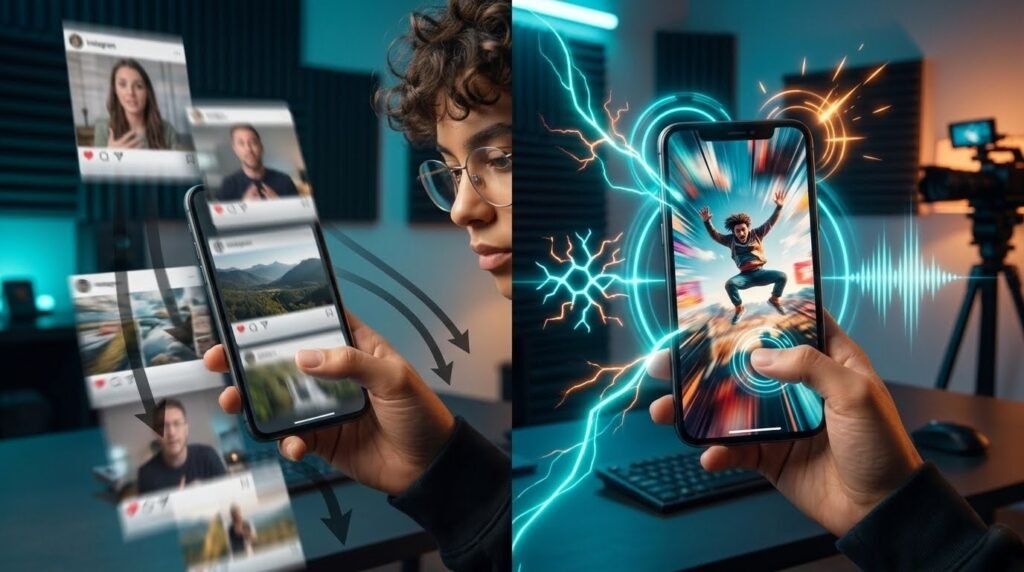
Motion is the third mechanism. Static visuals, even beautiful ones, don’t create the same involuntary attention that movement does. A clip already mid-motion when it starts, a camera already pushing in, an action already underway, a transition already happening occupies visual attention before the scroll reflex can fire.
Emotional triggers operate underneath all of this. Tension, surprise, recognition, humor and emotional responses are faster than rational evaluation. A clip that produces an emotional response in the first second holds attention through the processing that follows.
Generic intros fail because they trigger none of these. A wide, slowly establishing shot. A creator standing still about to speak. A branded animation playing out patiently. These all assume a viewer who has already decided to watch, which is the one thing a hook clip cannot assume.
The Biggest Mistakes People Make When Choosing Hook Clips
Picking cinematic footage over attention-grabbing footage is the most common mistake. Wide establishing shots, slow push-ins, beautifully lit landscapes this footage was design to watch by someone already watching. It’s compose for patience that short-form audiences don’t have. The visual quality is often genuinely high while the hook effectiveness is essentially zero.
Slow openings kill retention before the content begins. A clip that takes more than a second to develop energy assumes the viewer will wait for something to happen. On TikTok, Reels, and Shorts, the viewer won’t. Energy needs to exist at frame one, not build toward it.
Choosing clips unrelated to the content’s emotional register creates a mismatch the viewer feels without identifying. A high-tension, dark opener leading into light, casual content breaks the implicit promise made in the first second. The viewer stops for the hook and finds something that doesn’t match it and that specific mismatch produces exits rather than retention.
Overusing trendy effects is a separate problem. An effect that’s been used in thousands of videos stops being a pattern interrupt and becomes the pattern itself. Viewers recognize it, categorize it as a template, and scroll because the recognizable template signals nothing new is coming.
Copying viral creators without understanding why their hook worked almost never transfers. A hook that works for a creator with an established audience, a specific niche aesthetic, and a viewer base primed to recognize their style fails completely for a different creator with different context. The clip isn’t the whole hook; the creator’s setup and audience relationship are part of it too.
How to Choose Hook Clips That Actually Improve Retention
Speed is the first filter. Does the clip have visual energy at the first frame, or does it build toward energy? Anything that requires more than half a second to develop momentum is starting too slow for short-form. This eliminates the majority of general stock footage immediately.
Visual contrast is the second filter. Does the clip look different from a typical feed? High contrast between dark and light, an unexpected angle, an unusual subject position these create the visual distinctiveness that triggers the involuntary pause. A clip that looks like everything else in a feed won’t interrupt anything.
Emotional impact is the third. Watch the clip with no context and identify what the first feeling is. Tension, surprise, curiosity, recognition, discomfort any of these is useful. Neutrality isn’t. A clip that produces no emotional response in isolation won’t produce one in a feed.
Curiosity potential is the fourth filter. Does the clip show something partially an action mid-completion, a result without its cause, a moment that implies context the viewer doesn’t have yet? The partial show is almost always more effective than the complete visual because the complete visual resolves the question before it’s been asked.
Transition potential matters for clips combine with a cut or effect. A clip that peaks at a specific moment, a hand making contact with something, a face at maximum expression, a camera reaching the end of a move gives a precise frame to cut on. Clips without a clear peak moment are harder to use effectively as transitional hooks.
Replay value is the last filter and the one most people skip. Does the clip have anything in it that rewards a second watch? A detail that wasn’t obvious at first, a moment that recon textualizes something else in the video, these small elements drive the rewatch behavior that platforms weigh heavily in distribution decisions.
Generic Stock Libraries vs Dedicated Hook Libraries
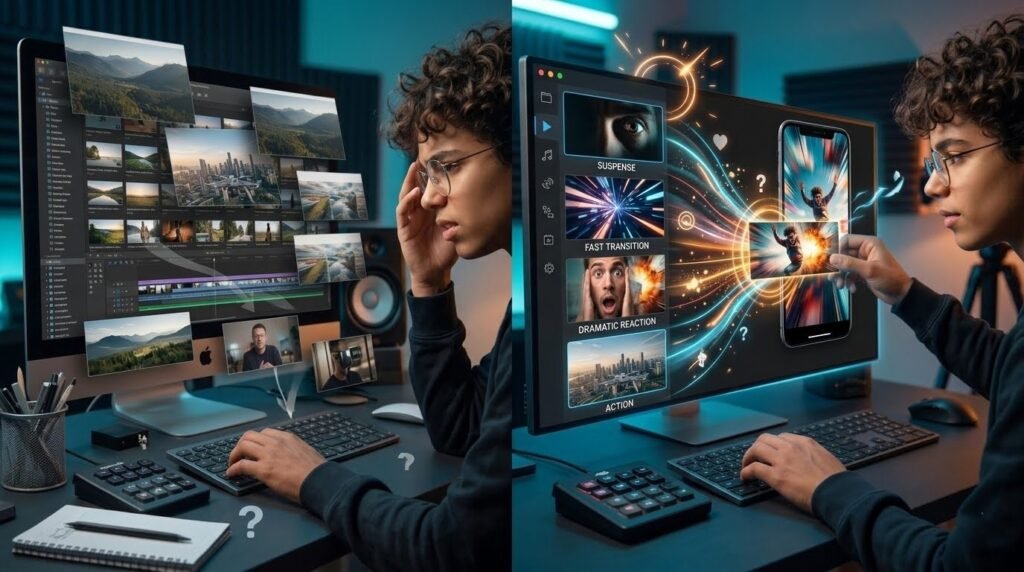
The search experience tells the difference quickly. Type “hook clip” or “transitional hook” into a general stock library and the results are mostly slow, wide, cinematic footage that doesn’t fit the use case. The algorithm returns what the term most commonly matches across general use, not what short-form creators specifically need.
Dedicated hook libraries organize by function rather than subject. Suspense clips are group with suspense clips. Transitional hooks are findable as transitional hooks. UGC video hook clips are separate from motion graphic openers. That organizational difference saves more time than it sounds like on paper across a full week of content production, it compounds significantly.
Clip composition is different at the source level too. General stock footage is shoot for versatility, wide, slow, adaptable to many contexts. Hook clips need to shot with frame-one energy as the goal, which changes camera distance, movement speed, subject positioning, and timing. Most general stock footage wasn’t shot with any of that in mind because it wasn’t built for this use case.
Licensing clarity is cleaner in dedicated libraries for the same reason. Platforms built specifically for short-form creators tend to address commercial use, ad use, and client work explicitly rather than burying the terms in language written for different industries.
HookTransition.com sits in the dedicated library category built specifically around transitional hooks, scroll stopping clips, and video hooks downloaded organized by type for short-form vertical content. For creators who’ve spent time hunting through general stock sites for something with hook-level energy and come up mostly empty, having a library organized around that specific need changes the production workflow in a practical way.
Building Your Own High-Performing Hook Collection
The most valuable hook library a creator can have is one built from personal performance data clips that have demonstrably moved retention numbers on specific videos rather than clips that looked good in a preview window.
Start by saving clips that produce measurably better early retention. Not clips that seemed promising clips that actually performed. The retention graph two days after posting tells the truth about whether the hook worked.
Categorize by hook style rather than by subject matter. Suspense hooks in one folder. Transitional hooks in another. UGC-style openers separate from motion graphic clips. Pattern interrupts separate from reveal hooks. The categorization should match how hook decisions get make what the opening needs to accomplish, not what it looks like.
Label by niche compatibility where that’s relevant. A suspense clip that works for finance content might not transfer to lifestyle. Noting which content categories a clip has worked in makes future reuse faster and more reliable.
Review and replace regularly. A clip that stopped a scroll six months ago might not work the same way today if it’s become pattern rather than pattern interrupt. TikTok retention strategy requires that the hook library stays current what’s recognizable as a template gets scrolled past, so the collection needs periodic fresh additions.

Hook Video Clips Library
The most impressive-looking clip in a free pack is rarely the one that moves the retention graph. Hook clips that actually stop the scroll don’t win on visual quality, they win on what they do to a viewer’s attention in the first second before any content evaluation happens.
Building a curated hook video clips library around clips that have actually organized by type, labeled by niche fit, refreshed regularly is worth more than downloading a hundred clips and hoping something works. The library gets more useful the longer it exists, and the retention data behind it makes every future hook decision faster and more grounded than starting from instinct.


