Ran a split test last year that genuinely caught me off guard. Same product, same offer, same targeting. Two creatives, one professionally shot with clean lighting, branded graphics, polished voiceover, the kind of UGC Video Hook Clips that clearly had a budget behind it. The other was a phone recording in someone’s kitchen, slightly shaky, a real person talking to the lens like they were leaving a voice message for a friend. No studio, no script visible, no production value worth mentioning.
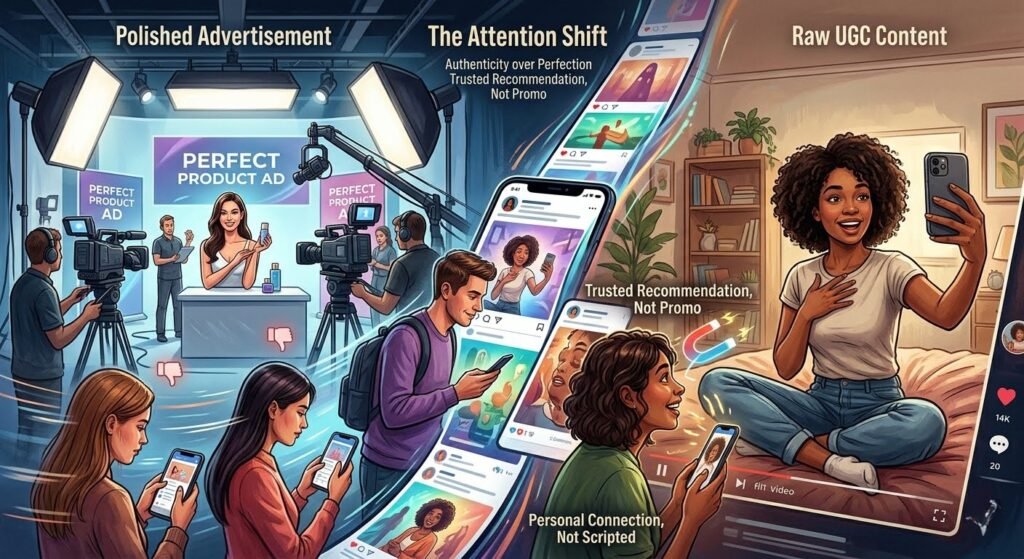
Showed those numbers to a few media buyers and none of them were surprised. That result, or something close to it, keeps showing up across ecommerce, beauty, fitness, software categories that have nothing obvious in common except that UGC video hook clips are consistently outperforming produced content in them. Worth understanding why.
Why People Trust Raw Content More Than Traditional Ads
Something happens in the brain the moment a video opens on perfect lighting and a professionally scripted presenter standing in front of a branded backdrop. It gets to file. Automatically, before the viewer has processed a single word filed as advertising. And once that filing happens, a whole set of behaviors activates that polished content then has to fight against for its entire runtime. Skepticism. Reduced attention. The reflex to skip before the message lands.
Phone camera footage doesn’t get file the same way. Someone talking in natural light, background slightly out of focus, framing a little off-center that reads as a person sharing something rather than a brand running something. The filing decision happens in under a second and it changes everything about how the rest of the video gets process.
What Are UGC Video Hook Clips?
Short answer: the opening one to four seconds of a video that looks and feels like something a real person filmed on their own phone for their own reasons. Longer answer: UGC video hook clips are opening sequences built around the visual and emotional characteristics of genuine user content handheld framing, natural light, direct-to-camera delivery, real environments in the background, the kind of slightly unpolished energy that implies someone hit record because they wanted to share something, not because a brand briefed them to.
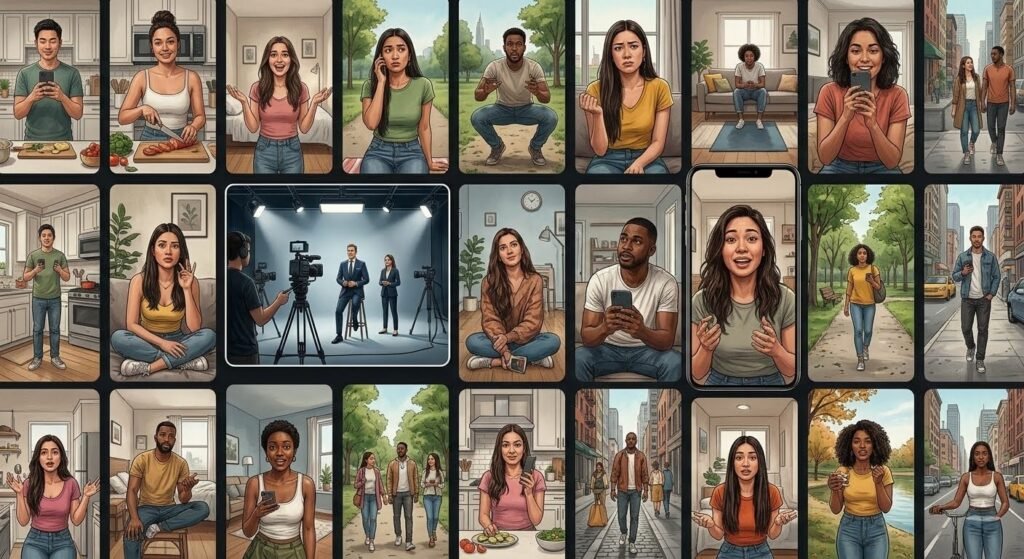
One distinction worth making clearly because it causes confusion: UGC content is a whole video make in an authentic style. A UGC hook clip is just the opening moment, the part that determines whether anyone watches the rest. Some videos run UGC style all the way through. Others use a raw authentic opener and shift into more structured content afterward. Both work. The hook is the piece that earns the next ten seconds regardless of what format follows it.
Why UGC Hooks Perform So Well on TikTok and Reels
TikTok is not a broadcast environment. Neither is Instagram Reels. Both are feeds built almost entirely around personal content, people filming themselves, sharing moments, reacting to things, talking directly to their audience. Polished production is genuinely rare in those feeds. When it shows up, it stands out. Not in a good way.
A produced ad in a TikTok feed creates a visual mismatch with everything around it. The viewer notices not consciously, necessarily, but the mismatch registers. The content gets identified as different from the personal content surrounding it, which means it gets identified as advertising, which means it gets processed in skeptic mode before the message has had any chance to land.
UGC video hook clips don’t create that mismatch. They look like TikTok. They look like the fifteen videos the viewer just scroll past, which means they get process in the same mode as those fifteen videos, the mode where people are actually watching rather than filtering. That’s the whole advantage, honestly.
The Psychology Behind Authentic-Looking Content
Fast categorization is running constantly underneath conscious viewing. The brain is classifying content before the viewer has formed an opinion about it personal or promotional, trustworthy or suspect, worth attention or worth skipping. These classifications happen on visual cues that aren’t consciously processed: camera type, lighting source, background environment, delivery style.
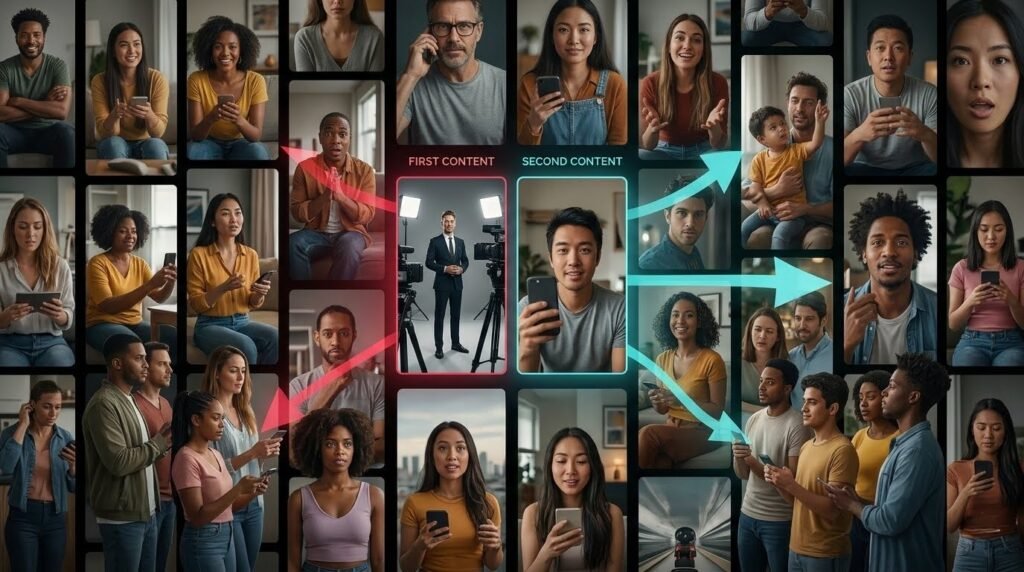
Content that gets classified as personal activates a different engagement mode than content classified as promotional. Personal content gets evaluated on what it’s actually saying. Promotional content gets evaluated on what it’s trying to sell, which is a fundamentally more defensive posture that reduces receptiveness to the message regardless of how good the message is.
Two videos. Same product. Same claims. One produced, one raw. The raw version typically generates better watch time, lower cost per click, higher conversion rate not because it’s higher quality but because the viewer processed it in a more open state. The message landed on someone who was listening rather than someone who was screening.
How UGC Video Hook Clips Increase Watch Time
Early retention is the variable that matters most in the opening seconds, and it’s the variable that determines whether an algorithm distributes content further or quietly limits its reach. High retention through the first five seconds signals the platform that viewers found something worth staying for. Drop-off in the first two seconds, especially steep drop-off, signals the opposite and the platform responds by pulling back on distribution without any notification or explanation.
Two things happen when a UGC video hook clip opens an ad or a piece of content. The skip reflex fires later. Polished advertising triggers immediate identification as an ad, and ad identification triggers the skip impulse almost automatically particularly on platforms where viewers have developed fast skip habits. Raw, authentic-looking content doesn’t get identify as fast. The reflex is slower. Slower means more viewers clearing the opening window.
Past that initial delay, relatability takes over from the authenticity signal. Seeing someone who looks like a real person, in a real environment, sharing something in a way that sounds genuine creates curiosity about what they’re saying and curiosity is stickier than the initial attention-grab. The hook creates the opening. The relatability extends it into actual watch time.
The Best Types of UGC Hook Clips
Selfie-Style Openers
Phone at arm’s length, face in frame, talking directly to the lens and starting immediately, no introduction, straight into the point or mid-point. The framing alone communicates personal and direct before any audio registers. Works across almost every category because there’s an intimacy in that format that nothing else quite replicates. The key detail most creators get wrong: starting at the beginning of a thought rather than inside one. Problem-Solution Hooks The problem is first shown visually before it gets named. Dry irritated skin in close-up before any product appears. A software workflow visibly frustrates someone before any tool is introduced. A physical limitation mid-exercise before the fix arrives.
Product Discovery Hooks
The moment of encountering something: a hand reaching for an object not yet shown, a package being opened on a real countertop, something being picked up without the camera showing what it is yet. Not the product itself, but the moment around the product. Discovery framing implies the viewer is watching something happen rather than watching something.
Reaction-Based Hooks
The reaction before the cause. A genuine expression of surprise, disbelief, something between satisfaction and shock as the first frame, before whatever caused it has shown. The viewer mirrors the emotional response automatically before they’ve processed any product or brand information, and that mirroring creates a pull toward the cause that’s hard to scroll past.
Testimonial Hooks
Opening on the outcome or the emotional state rather than on the testimonial structure. “Three weeks in and I genuinely didn’t think it was going to do anything” is a testimonial hook. It implies skepticism, implies a journey, implies an honest verdict all before the product is named. The structure of a traditional testimonial person introduces.
Day-in-the-Life Hooks
Dropping into a real moment mid-morning routine, mid-task, mid-commute without setup. The viewer gets placed inside a scene that’s already happening rather than presented with content about a scene. This works particularly well for lifestyle, fitness, and software.
UGC Hooks vs Professional Brand Commercials
Broadcast environments television, YouTube pre-roll, placements where the viewer has consciously opted into a content experience reward production quality because production quality signals investment and investment signals credibility. In those environments, a polished commercial works the way it was designed to. The viewer is passive, the content interrupts, the interruption is expect, the quality supports the message.
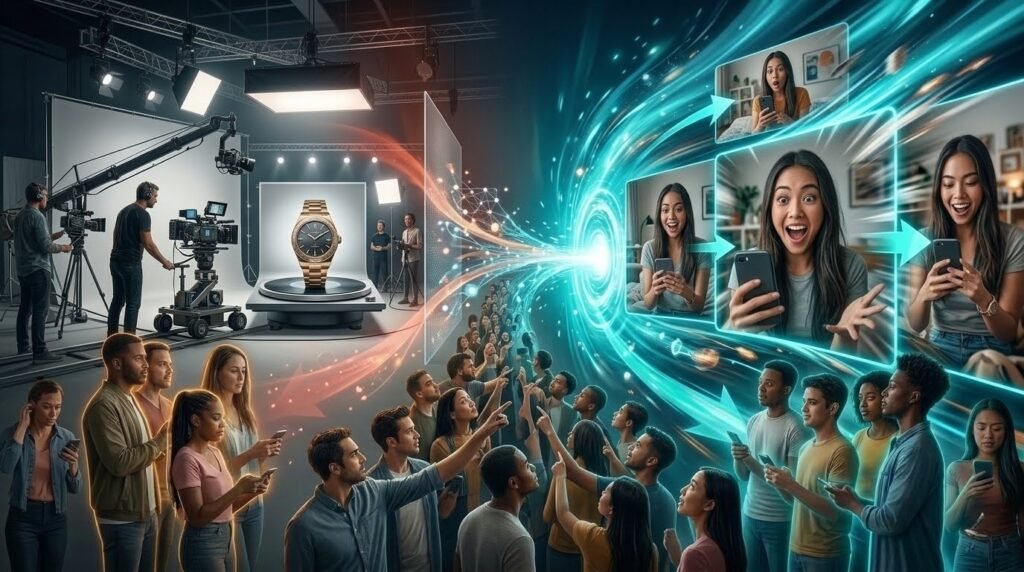
Short-form social feeds don’t work that way. The viewer is active and in control, surrounded by content from real people, scrolling fast, with no expectation that advertising will appear or obligation to watch it when it does. A broadcast-quality commercial dropped into that environment triggers all the identification and filtering behaviors that the environment has trained viewers to apply to anything that looks like it doesn’t belong.
How to Combine UGC Hooks With Transitional Hooks
Authenticity from the UGC opening plus physical momentum from a transitional hook produces something harder to scroll past than either element produces on its own.
Reaction-based hooks pair particularly well with zoom transitions. The zoom landing at the peak of the reaction, the highest point of the expression, amplifies the emotional signal while keeping the handheld feel of the original clip intact. The viewer gets authentic emotion and visual momentum at the same moment, which is a difficult combination to scroll past without actively trying.
Timing the transition is the specific skill here. It goes at the highest-energy frame of the clip not before the energy builds and not after it’s already peaked. Finding that frame, placing the cut there, and making sure the content after the cut matches the energy of the clip rather than immediately dropping into something calm.
Examples of High-Performing UGC Openers
A skincare brand’s ad opens on a hand holding a product in a real bathroom counter visible, slightly cluttered, clearly not a set and a creator mid-sentence: “…honestly thought this was going to be another thing I tried once and forgot about.” The skepticism in the opening line, delivered in an environment that looks like the viewer’s own bathroom, creates a relatability that a studio presentation of the same product never would.
A software company’s ad opens on a frustrated face, home office visible in the background, a mouse clicking repeatedly on something that clearly isn’t working and the line: “Three hours. I wasted three hours on something I now do in thirty seconds.” The frustration is show and feel before any solution appears.
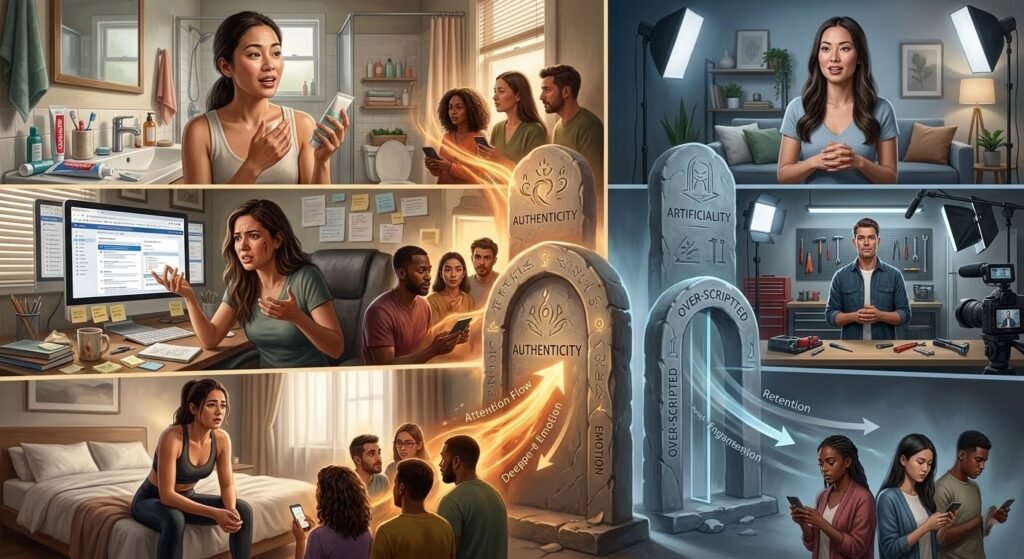
A fitness app ad opens on someone visible from the shoulder down, sitting on the edge of a bed in workout clothes, looking at their phone. No movement. A few seconds of stillness. Then quietly: “I was about to skip it again.” The admission of resistance, the specific, recognizable feeling of not wanting to do the thing you know you should do is the entire hook.
Common UGC Hook Mistakes That Hurt Retention
Opening with an introduction. “Hey guys, so I wanted to share something with you today” tells the viewer that the content starts in a moment. A moment is too long. The content has to start now or preferably past now, mid-point, already inside something.
Scripting too tightly. Natural speech has rhythm irregularities, slight pauses, the occasional restart, conversational pacing that doesn’t sound like copy. A perfectly delivered, clearly rehearsed script in a phone-camera format creates a mismatch the viewer feels without being able to name. The format reads as authentic; the delivery reads as scripted.
Production elements bleeding into the UGC aesthetic. Branded props visible in the background. Lighting that’s too even and soft to have come from a window. Audio that’s been process in a way that real phone recordings aren’t.
How Brands and Agencies Build Libraries of UGC Hook Clips
At scale, UGC hooks stop being creative decisions and start being infrastructure. Agencies running paid social across multiple clients treat hook libraries the way other teams treat asset libraries organized, tested, categorized, ready to pull rather than rebuild on every brief.
The testing framework that produces usable data: three to five UGC hook variants running against the same ad body. Track two-second view rate and thumb-stop rate specifically in the opening window. The hook producing the strongest early retention gets scale. Everything else gets archive rather than discarded. A hook that underperforms with one audience segment sometimes produces completely different results with another.
Building the library means categorizing by hook type, by emotional trigger, by niche relevance, and by platform format. A reaction hook that works for a beauty brand might need re-filming for a software context. A problem-solution hook from a fitness campaign might transfer directly to a supplement campaign with minimal adaptation.
Where to Find UGC Hook Clips for Content and Ads
Three real options, each with different practical tradeoffs. Working with UGC creators directly produces the highest-quality brand-specific content. Creators who specialize in UGC production understand the authenticity requirements from the inside. They know how to film something that reads as genuine. Even when it’s been commission, which is a skill that’s harder than it looks. Cost and turnaround are the constraints.
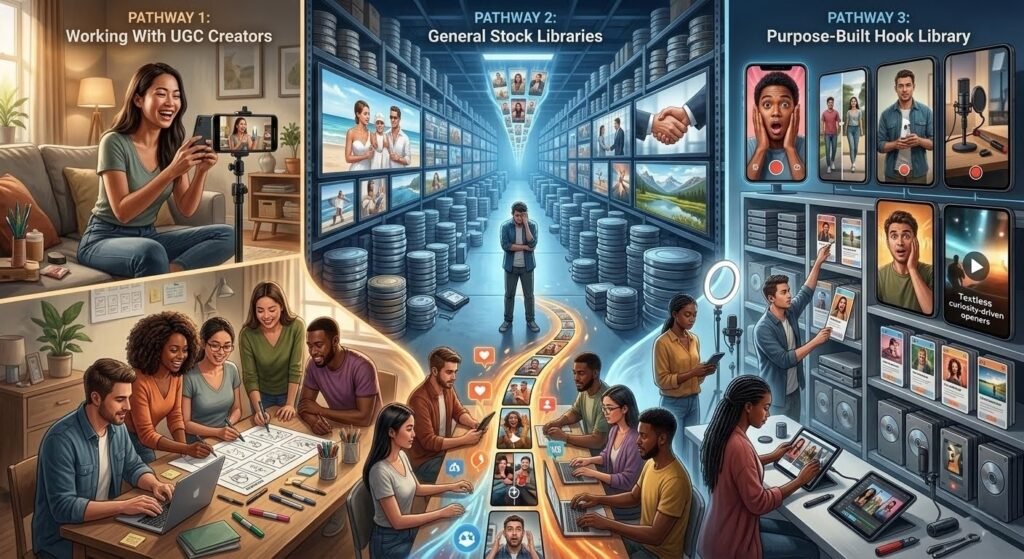
General stock libraries are accessible but largely wrong for this. Pexels, Pixabay, similar platforms solid for b-roll and cinematic footage, built for that purpose. Not built for raw authentic short-form hooks. Searching those platforms for something with genuine UGC energy usually produces a long session of irrelevant results before anything usable.
Purpose-built hook libraries fill the gap between those two. HookTransition.com was built specifically for creators, brands, and agencies who need reel hooks with no copyright concerns attached UGC video hook clips, transitional hooks, and scroll-stopping openers organized by type and sized for vertical platforms.


