Most creators think losing viewers is a content problem. Wrong niche, wrong topic, wrong energy. So they change the content. Film something different. Try a new format. Retention graphs look the same. Video Hooks are way to overcome this.
The are problem almost never lives in the middle of the video. It lives in the first two seconds, the opening moment where the viewer makes a completely unconscious decision about whether to stay or leave. That decision happens before the content has delivered anything worth evaluating. Before the point lands. Before the value is clear.
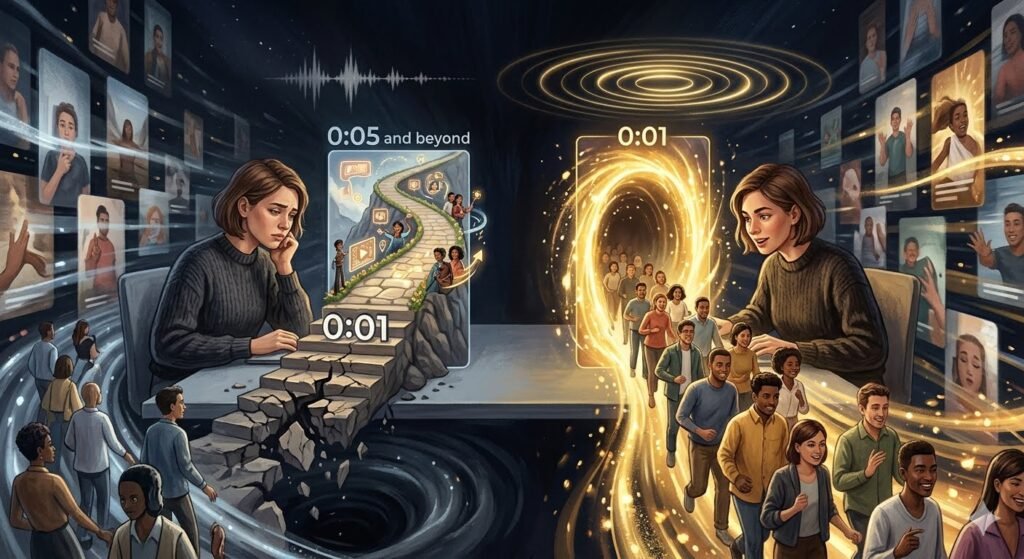
Video hooks that increase watch time solve that specific problem.The content isn’t the problem most of the time. Spent long enough looking at retention graphs across different accounts to say that with some confidence. The middle of the video holds. The end holds. The drop happens at the start before the content has said anything worth evaluating, before the value has had a chance to show itself. Getting the opening right isn’t about polishing the message. It’s about buying the message enough time to land.
TikTok, Reels, and Shorts all respond to the same behavior of how long people actually stay when a video starts playing. Post something that holds viewers through the first few seconds at a strong rate and the platform pushes it further. Get the hook right and the algorithm works with the content. Get it wrong and the content never gets a fair audience regardless of its quality.
Why Watch Time Matters More Than Views
Views count how many times a video loads. Watch time measures what happens after that and platforms care far more about the second number than the first. Completion rate is the percentage of viewers who watch to the end. High completion rate tells the algorithm the content earned its runtime. A video with fifty thousand views and a forty percent completion rate outperforms a video with two hundred thousand views and an eight percent completion rate in terms of distribution signals.
Replay rate adds another layer. Replays tell the platform something like what the viewer chose to go back. Nobody replays a video by accident. That active return is weighted heavily by TikTok and Reels because it implies the content was worth a second look, which is a harder standard to meet than simply stopping someone mid-scroll. Creators who engineer their endings to flow back into the opening naturally, not obviously, just smoothly enough that re-watching feels like a continuation rather than a repetition tend to see that signal show up in their distribution numbers over time.
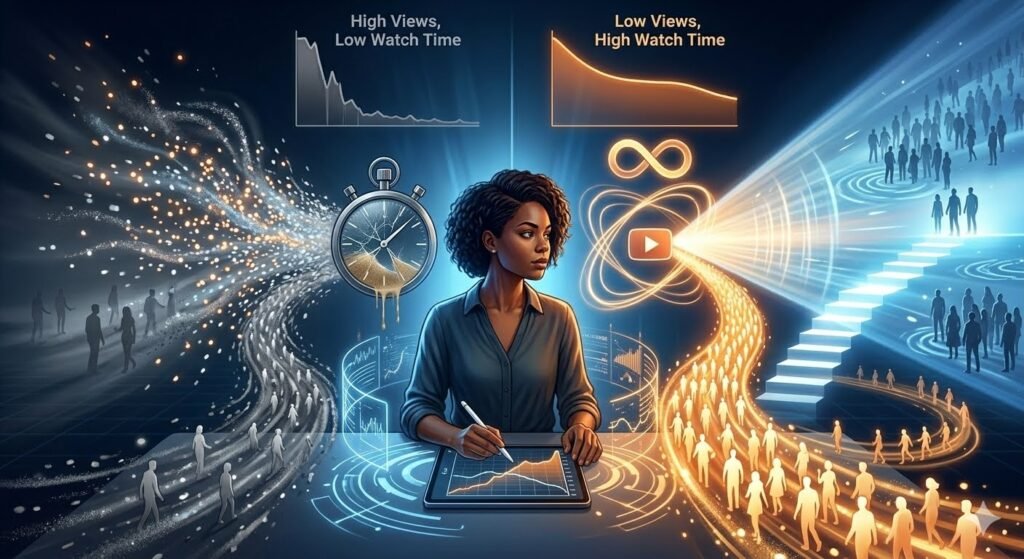
Audience retention graphs show exactly where viewers leave. The most useful data point in the graph isn’t the final completion percentage, it’s the shape of the drop in the first five seconds. A sharp early cliff means the hook failed. A gradual decline means the content held initially and lost people as it progressed, which is a different and more solvable problem.
Every metric that matters traces back to the opening. Fix the hook and completion rate, replay rate, and audience retention all move. That’s why video hooks that increase watch time deserve more attention than most creators give them.
What Makes a Video Hook Increase Watch Time?
Four psychological mechanisms drive hook performance. Understanding them makes every hook decision easier.
Curiosity creates forward momentum. When a video opens with something unresolved, a result without its cause, a statement with obvious implications that haven’t been explained, a visual that raises a question, the viewer’s brain moves toward resolution. The itch to find out what happens is more reliable than any perfectly crafted opening line.
Motion triggers involuntary attention. Motion at the opening frame does something that a static image or a person about to start talking simply cannot occupy the eye before any decision about whether to watch has been made. By the time that decision arrives, the video is already a second or two in and leaving feels like interrupting something rather than skipping past it. Scrolling on short-form platforms runs mostly on habit.
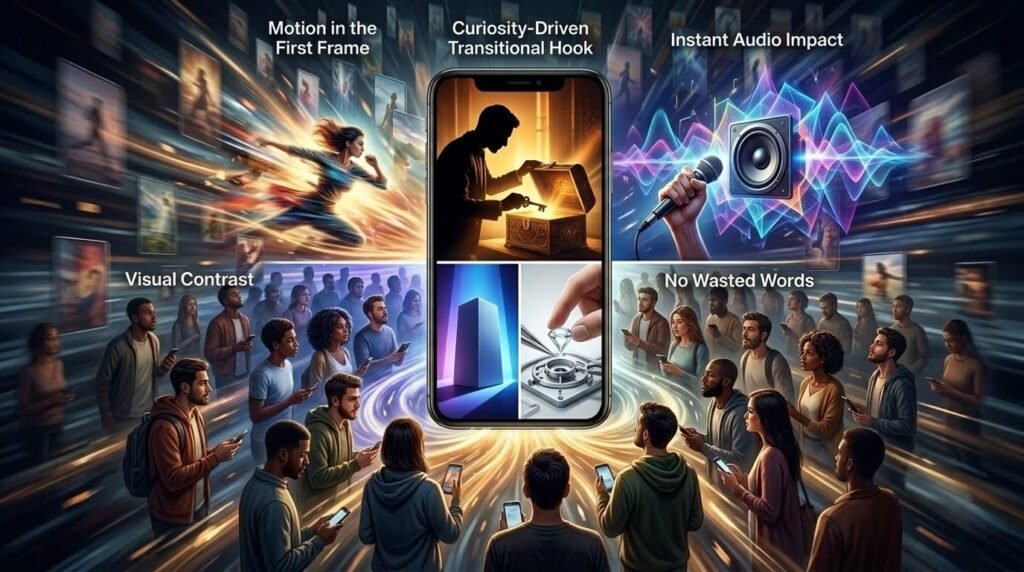
Something unexpected: a visual mismatch, an audio disruption, an opening that doesn’t match the pattern of the hundred videos before it breaks the automatic behavior and forces active attention.
Anticipation keeps viewers watching past the hook. When an opening implies a payoff is coming, a result about to be revealed, a question about to be answered, a process about to be shown, the viewer stays to collect that payoff. The promise made in the opening extends watch time through the body of the video without requiring additional hooks to maintain it.
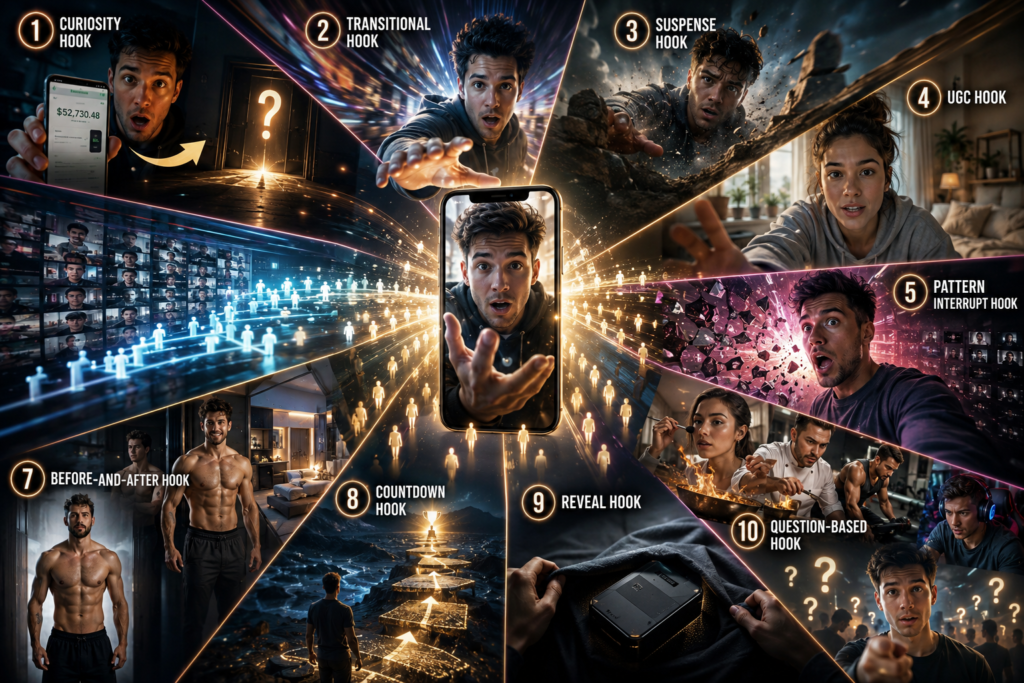
10 Video Hooks That Consistently Increase Watch Time
- Curiosity Hooks: Open with the result, not the process. A finance creator shows a bank balance screenshot before explaining how it happened. An ecommerce brand shows the finished product before the creation process begins. The viewer’s natural question is how the transitional hook is. As long as the video answers it, the curiosity hook earns its watch time.
- Transitional Hooks: A fast cut, whip pan, or zoom that lands at the exact moment the opening line delivers. The motion and the message arrive simultaneously, creating two simultaneous reasons to stay. Transitional hooks are the mechanical backbone of stop the scroll video content; they add physical momentum to whatever verbal or visual hook is already there.
- Suspense Hooks: Drop into tension without explaining it. A business creator cuts in mid-crisis. A fitness creator opens on a moment of physical failure. A gaming creator opens on a reaction before showing what caused it. The suspense mechanism works on cold audiences who don’t know the creator yet because implied stakes don’t require familiarity to land.
- UGC Hooks: Phone camera, natural light, direct to lens someone talking like they’re leaving a voice note rather than performing for a brand. UGC video hook clips work because they bypass the skip reflex that polished advertising triggers. The viewer doesn’t identify the content as an ad fast enough to activate skeptic mode, which means the message reaches them in a more receptive state.
- Pattern Interrupt Hooks: Something wrong, an audio cue that doesn’t fit, a visual that breaks expected flow, a color shift, a jarring cut at an unexpected moment. The disruption gets flagged as important before any conscious evaluation kicks in. Particularly effective as attention grabbing video openers for cold audiences with no prior exposure to the creator.
- Mid-Action Openers: The video is already inside a moment when it starts. A beauty creator mid-application. A chef mid-technique. A business creator mid-decision. The viewer gets dropped into something already happening and scrambles for context and scrambling means watching. These openers create forward momentum that static openings can never replicate.
- Before-and-After Hooks: Show the after immediately, without the before. A transformation result with no timeline shown. A finished product with no process visible yet. A business outcome with no strategy explained. The question every result creates keeps viewers watching through the explanation. Works consistently across fitness, beauty, education, finance, and lifestyle content.
- Countdown Hooks: Countdown hooks work because they make an implicit deal with the viewer upfront. “Three things” or “two mistakes” tells someone exactly what they signed up for before they’ve committed to watching. There’s a number, there’s a structure, there’s a point where it ends. That clarity removes a specific kind of drop-off that happens mid-video when viewers aren’t sure how much longer something is going to run. Educational and business content benefits from this more than most other categories because the viewer came for information.
- Reveal Hooks: Something partially visible. A product held at an angle that doesn’t show the label yet. A result cropped just outside the frame. A before-and-after where the after is blurred. The partial reveal creates a visual promise there’s something here worth seeing that the viewer cashes in by watching. Used heavily in beauty, product, and transformation content.
- Question-Based Hooks: A question the target viewer is already asking themselves, delivered directly to camera without preamble. A SaaS creator: “Why does this take three hours when it could take three minutes?” A fitness creator: “Why are you still training the same way you were two years ago?” The question works when the viewer has already had it; it creates instant identification before any content is delivered.
Why Most Hooks Fail
Understanding what breaks a hook is as useful as knowing what makes one work. Talking too long before the point. Every second spent approaching the content is a second the viewer isn’t inside it yet. Not being inside it yet is skippable. The Transitional hook has to start at the point or past it never before it.
Static openings. A person standing still before they start speaking gives the scroll reflex time to fire. The video needs to be in motion at frame one not dramatically, just visibly. Even a slight camera movement or a cut before the first word reads as more dynamic than a locked-off talking head starting from stillness.
Giving away the answer immediately. A curiosity hook with the answer in the first sentence closes the loop before it can do any work. The point of the hook is to create a question, not answer one. Answers belong in the body of the video, not the opening.
Weak audio design. A visually strong hook with flat, low-energy audio loses half of what made the visual work. Sound design in the opening a bass hit on a cut, silence before a reveal, an audio element that doesn’t quite match the visual creates layered interruption that holds more effectively than either element alone.
Mismatched energy. An intense, dramatic opener leading into casual, slow-paced content breaks the implicit promise made in the first two seconds. The viewer stops for the hook. If the content doesn’t match the energy of that hook, they leave feeling misled and that exit is more damaging to retention metrics than a quiet early drop-off.
How to Combine Hooks With Transitions
A hook without a transition is a static claim. A transition without a hook is motion without direction. Together they create something that’s genuinely difficult to scroll past a video that’s already physically moving while simultaneously creating a reason to stay.
Whip pans work well over suspense and mid-action hooks. The fast lateral movement paired with a hard cut creates kinetic energy that extends the tension of the opening clip into the first line of content.
Zoom-ins land best at the peak moment, the frame where the visual tension is highest or the emotional signal is strongest. A zoom landing there amplifies whatever the hook was already doing rather than interrupting it.
Fast cuts paired with audio hits, a bass drop, a sudden silence, a sound cue that lands exactly on the cut create combined sensory interruption that’s harder to scroll past than either a visual transition or an audio change would produce alone.
Push-ins work particularly well for UGC-style hooks and direct-to-camera content. A subtle push landing as the creator delivers the hook line maintains the authentic feel of the UGC format while adding the visual momentum that a short video transition for ads requires to perform in competitive placements.
Motion graphics as transitional elements work for educational and SaaS content where text-based hooks need visual support. Bold text hitting the screen on a cut, paired with a strong audio moment, extends the hook energy into the first informational beat without breaking the content’s pacing.
HookTransition.com has a library of transitional hooks, stop-scroll openers, and hook video clips built specifically for short-form vertical content organized by hook type and ready to use for creators who want tested assets without building everything from scratch.
Creating a Repeatable Hook System
Testing hooks one at a time on individual videos produces noise rather than data. The content topic, posting time, and audience variance all affect results independently of the hook. Getting clean data requires isolating the hook as the variable which means running the same hook style across multiple videos before drawing conclusions.
Pick one hook type. Use it consistently across four to five videos. After each one, check two numbers specifically: where the retention curve drops sharply in the first five seconds, and what percentage of viewers replay. Drop-off location shows where the hook stopped working. Replay rate shows whether the opening created a loop effect worth scaling.
Compare against personal baseline not platform averages, not competitor benchmarks, the previous videos on the same account. If early retention improves and replay rate moves upward, the hook type is working for that specific audience. If neither moves after five videos, change the hook type before changing anything else.
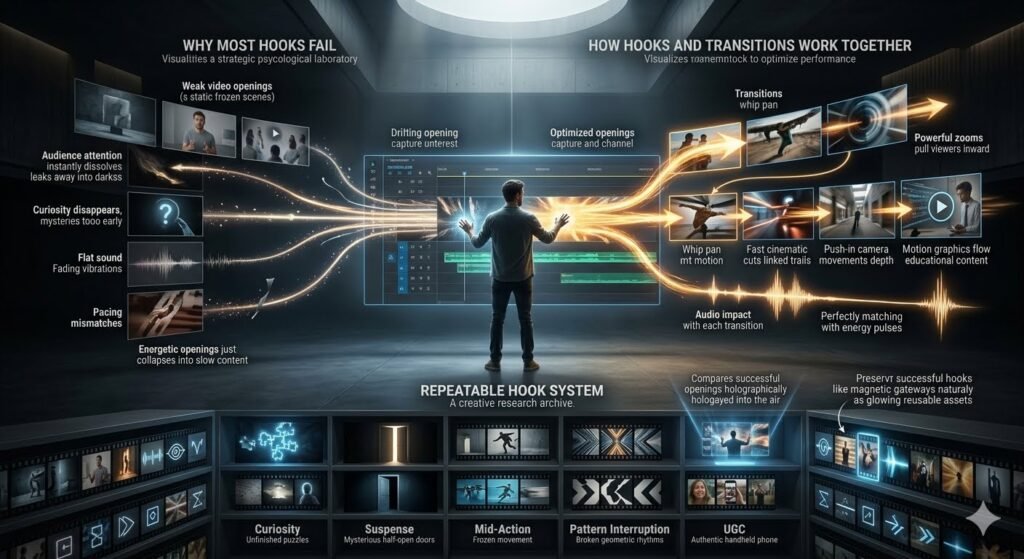
Build a folder of hook styles that have produced measurably different retention curves. Label them by type: curiosity, suspense, mid-action, pattern interrupt, UGC. When a new video needs an opener, go to the folder first. The hook that worked three videos ago for similar content is a better starting point than a fresh creative decision made under a deadline.
Most creators start from zero every time they need an opener. Blank timeline, try something, post it, move on. The hook that worked three videos ago doesn’t get noted anywhere. The one that flopped doesn’t either. Nothing accumulates. After a year of posting, the hook decision feels just as uncertain as it did at the beginning because nothing was ever tracked.
A folder that documents which openings actually moved the retention numbers labeled by type, noted with the video it came from changes that. It’s not a mood board.
Retention graphs improves
Retention graphs don’t lie about where viewers decided to leave. In most cases that decision happens in the first two seconds before the content has had a chance to prove itself.
Video hooks that increase watch time solve that problem at the source. Not by making the content better, but by making the opening earn the next thirty seconds. Pick one hook style from this article, drop it onto the front of the next video, and check the retention curve two days later. That single comparison will tell more than any amount of reading about hooks. The opening either holds people or it doesn’t. One test is all it takes to find out.


