Pull up the retention graph on the last TikTok that underperformed. Not the views, not the actual curve showing where people left. For most creators, the shape of that graph is the same regardless of the content: a steep drop in the first few seconds, then a relatively flat line through whatever’s left. The video held fine once people were actually watching it. The problem was getting them there.
Spent a while assuming that was a content quality issue. Better information, better delivery, better editing tried all of it. Retention graphs looked the same. The drop still happened at the two-second mark regardless of how much effort went into the middle of the video.
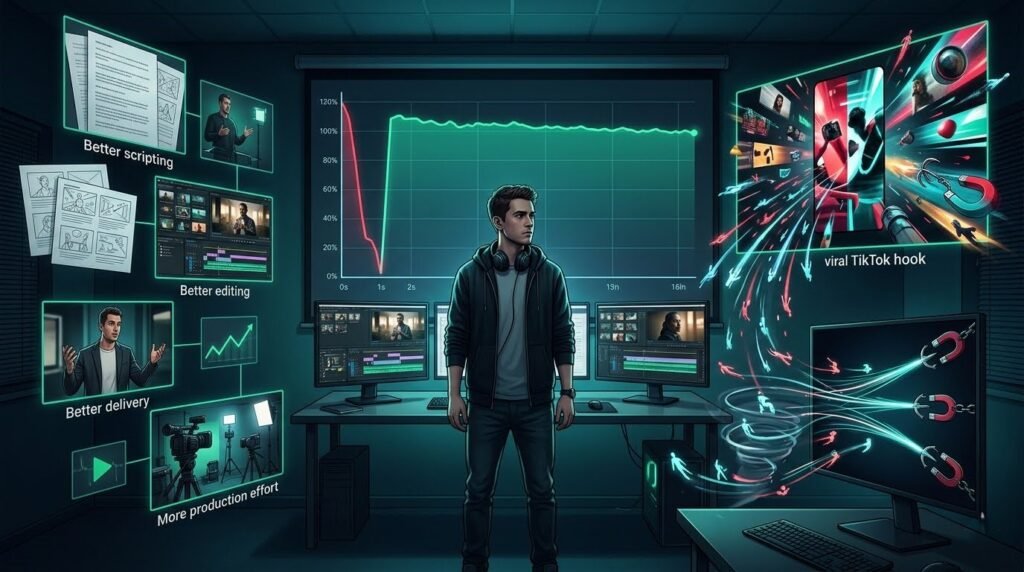
What actually changed things wasn’t the content at all. It was understanding what the opening needed to do not just say something interesting, but create a physical and visual condition where leaving felt harder than staying. That’s what viral hooks for TikTok are actually doing when you break them down. Not clever lines. Conditions.
Why Most TikTok Videos Lose Viewers Instantly
Here’s the thing about scrolling behavior that most creator advice glosses over viewers aren’t making deliberate decisions to skip your video. The thumb moves before any real evaluation happens. It’s reflexive. The video starts, nothing interrupts the scroll momentum, and they’re three videos past yours before their brain registered what it was looking at.
Static openings feed directly into that reflex. A person standing still. A slow zoom into a face. Someone about to say something. These patterns have been repeated so many times across TikTok that the viewer’s brain categorizes them instantly as content that starts after the intro and after the intro is too late. Nobody waits for the intro on short-form content. That patience left around 2020 and it’s not coming back.
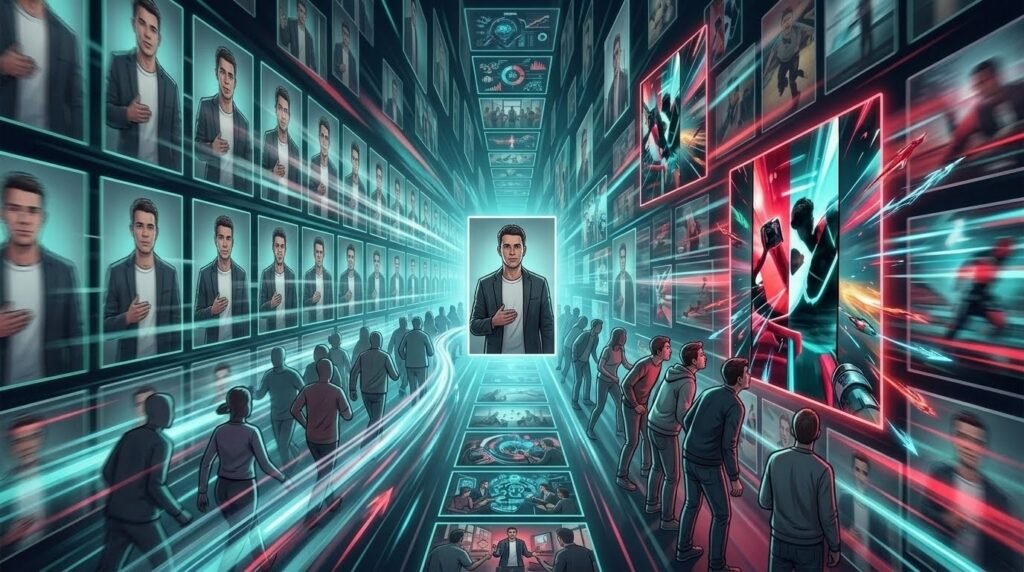
Pacing does a lot of damage too, and in a less obvious way. When a video feels like it’s approaching its point building context, setting up the premise, warming the viewer up that approach reads as delay. The viewer doesn’t think “this is building toward something good.” They think “this hasn’t started yet” and they leave. The creators holding attention through the first ten seconds aren’t making better content necessarily. They’re just not making the viewer wait for it to begin.
How TikTok Measures Watch Time and Retention
TikTok doesn’t reward views. It rewards what viewers do during those views, and two behaviors matter more than anything else.
Completion rate what percentage of people watch to the end. A high completion rate tells the platform the content earned its runtime. Low completion rate, especially when it’s front-loaded, tells the platform the opening failed and the content should be shown to fewer people. That consequence happens quietly. No notification. The video just stops reaching people and most creators never connect it back to the two-second drop-off they saw on the retention graph.
Rewatch rate is the second one, and it gets underestimated. When someone replays a TikTok, that’s an active choice more effortful than a like, and weighted accordingly by the algorithm. Videos that engineer a loop, where the ending connects back to the beginning naturally enough that a rewatch feels satisfying, see compounding distribution over time from that signal alone. A video hook to keep viewers watching isn’t just about holding them once. It’s about building an opening that makes coming back feel worth it.
Both of these things start at the same place. The opening. Fix the opening and both metrics move. Ignore it and no amount of work in the middle of the video shifts the graph.
What Makes a Hook Go Viral on TikTok
Watch enough high-performing TikToks across different niches to notice a few patterns that show up consistently and they’re not what most hook advice talks about. The video feels like it’s already been running. You land on it mid-thought, mid-action, mid-reaction, and your brain immediately starts trying to reconstruct what it missed. That reconstruction process is what keeps people watching. It’s not engagement in the traditional sense, it’s more like confusion that’s interesting enough to resolve.
There’s always a gap. Something shown without explanation. A result sitting there without the context of how it happened. A reaction to something the viewer hasn’t seen yet. The gap is doing the actual work not the words, not even the visual quality, but the distance between what’s visible and what isn’t. Human attention moves toward unresolved things. Always has.

Movement at frame one. On a platform full of static talking-head openers, a video that’s physically in motion when it starts reads differently. The eye follows movement before the brain decides whether to. That involuntary tracking is the window small, maybe a second and a half where the scroll reflex doesn’t fire because attention is already occupied.
And the actual hook beat, the moment that makes someone stop, is almost never longer than two seconds. What a lot of creators get wrong is treating the Transitional Hooks as the first ten seconds. It isn’t. It’s a single moment, usually under two seconds, and everything after that moment is content. The hook just buys the content a chance to be seen.
7 Transitional Hooks That Consistently Increase Watch Time
Suspense Openers
A fitness creator cuts in on shaking arms, a weight halfway to the floor, an expression that says something went wrong, no context, no setup, no explanation of what the video is. Just a moment that implies something happened and something is at stake.
That sequence works across every niche and the reason is simple: implied stakes don’t require category knowledge to land. A viewer with zero interest in fitness will still pause on physical distress. The Transitional Hook fires before the niche registers. By the time the viewer realizes they’re watching a fitness video, they’re already four seconds in and the content has its shot.
The business version of this: cut in on a tense expression, a screen showing a number that looks bad, or literally mid-sentence “…and that’s when we realized the whole strategy was wrong.” No setup. The realization has already happened. The viewer needs to know what led to it.
Mid-Action Openers
The video starts inside something already happening. Beauty creator: brush already moving, mid-application. Gaming creator: mid-reaction, something already happened on screen. Cooking creator: already mid-technique, hands moving, no preamble. The point is that nothing is being prepared or introduced; the video is already inside a moment when the viewer lands on it.
What happens in the viewer’s brain: immediate scramble for context. What did I miss? Where are we? That scramble is attention, and attention means watching. Mid-action openers create forward momentum that feels genuinely hard to interrupt because leaving means abandoning something mid-motion.
Pattern Interrupt Hooks
An audio cue that doesn’t match the visual. A color flash. A cut landing somewhere unexpected. Something that breaks the visual rhythm the viewer’s brain was predicting.
This one doesn’t need any content setup to work. The interruption is the hook. The brain flags the mismatch as significant before any conscious processing happens which produces a second or two of involuntary attention. Use that window to deliver the first real piece of content and the Transitional Hook has done everything it needed to.
Works particularly well as the opening frame of a stop the scroll video because it functions completely independently of niche, topic, or format.
Zoom Transition Hooks
Fast zoom, hard cut, right at the impact point. Can be layered under any of the other Transitional Hooks types without competing with them. What this does specifically signals pace and energy before a single word arrives. The viewer’s expectation for the rest of the video gets set in that first second, and a high-energy expectation is a reason to stay.

UGC Style Hooks
Phone camera. Slightly shaky. Someone talking directly to the lens like they’re leaving a voice note. No production polish, no color grade, no cinematic framing.
The lack of production is the point. It reads as real, and real moves faster to trust than polished content does particularly for affiliate content, product reviews, anything where the creator’s personal experience is supposed to be what makes the content worth watching. Imperfect signals are authentic. Authentic signals are trustworthy. Trustworthy keeps viewers watching longer than impressive production ever will.
Curiosity Hooks
Show the result. Not the process, not the context, not the journey, the result, immediately, sitting there without explanation.
Marketing creator: screenshot of numbers with no caption explaining them. Fitness creator: transformation photo with no timeline. Gaming creator: win screen, score visible, no gameplay shown yet. The question every result creates is how to Transitional Hook. The video just has to answer it.
Reveal Hooks
Something partially visible. Cropped. Blurred. Cut at the edge of the frame. The viewer sees enough to know there’s something worth seeing and not enough to see it. Works in beauty, product reveals, transformation content, lifestyle the tease mechanism transfers across categories without needing much adjustment. The promise is made in the first second. The rest of the video keeps it.
Why Transitional Hooks Outperform Static Openings
Static openers put the burden of decision entirely on the viewer before the content has done anything to earn that decision. Frozen frame. A person about to start talking. The viewer’s brain runs a fast evaluation on almost no information and on TikTok, where leaving costs nothing and the alternative feed is infinite, that evaluation fails the video more often than it passes it.
Transitional hooks shift that burden. The video is moving when the viewer’s eye lands on it. The cut has already happened, the zoom is already in progress, the action is already mid-frame and the eye is tracking it before the thumb gets a vote. By the time the conscious decision to stay or leave arrives, the viewer is already a few seconds in. A few seconds is enough for the content to justify continuing.
This is also why improving the middle of a video that’s bleeding viewers at the two-second mark doesn’t fix anything. The middle is fine. The middle is probably good. It just never gets seen because the opening didn’t create the conditions for seeing it. How to make videos more engaging fast almost always starts and ends at the opening not because everything else is less important, but because the opening is the door everything else sits behind.
Real Examples of Viral TikTok Hooks
Close-up of hands gripping a barbell, shaking, clearly at the limit caption: “the set that changed my training forever.” No context. No explanation. The viewer needs to know what happened because something clearly did.
Business creator, already mid-sentence: “…three years of doing it backwards and we had no idea.” Dropped into a realization. Stakes are obvious. The explanation hasn’t arrived yet. The viewer waits for it. Beauty creator, brush already moving on application, cut landing right on the product contact text overlay: “I cannot believe this works.” Reaction before reveal. The emotion lands first, the cause comes second. That reversal is the entire Transitional Hook.
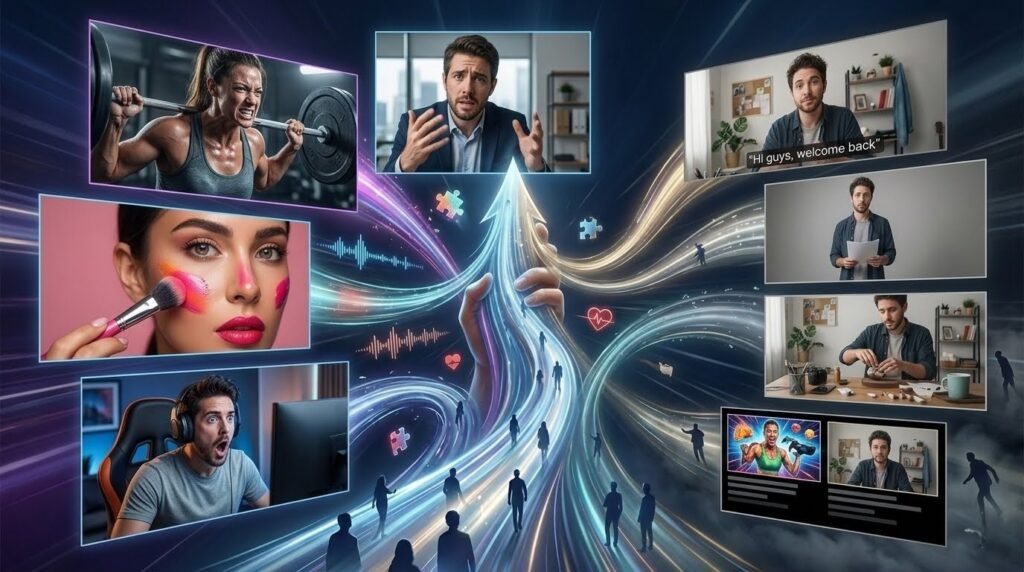
Gaming creator: reaction shot first wide eyes, pulling back from the screen then the gameplay moment that caused it. Emotional response before its trigger. Same reversal, different niche, same result. None of these needed a perfect opening line. Each one used structure and sequencing to create curiosity before any explanation was offered. That’s the actual skill of not writing the perfect sentence, but putting things in the right order.
Mistakes That Kill Watch Time
Opening with a greeting. “Hey guys welcome back” communicates one thing clearly: the content starts in a moment, not now. On TikTok, a moment is too long.
Holding still for too long at the start. A single second of a person standing before speaking is enough for the scroll reflex to fire. The video needs motion at frame one not dramatic motion, just motion.
Front-loading context. Explaining what the video covers before giving the viewer a reason to want to know that’s the table of contents problem. Nobody reads the table of contents before deciding whether they want the book. Give them a reason to want it first.
Building a strong Transitional Hook that leads into completely different energy. The opening sets an expectation. If the content after it doesn’t match the tone and stakes of that opening, the viewer feels misled and leaves. They don’t just leave, they leave with a bad association, which affects whether they stop on the next video too.
Audio left as an afterthought. An opening that’s visually strong but audio-flat loses half of what made the visual work. Sound and image hitting together, especially when they’re slightly mismatched in an interesting way, creates a stronger interruption than either element alone.
A Simple Hook Testing System for TikTok Creators
Pick one hook type. Use it across four or five consecutive videos without switching. Testing a different hook every video generates noise, not data the content topic, posting time, and audience variance all affect results, and isolating the hook as the variable requires repetition.
After each video, check two things: where the retention curve drops sharply and what percentage of viewers re-watched. Drop-off point shows where the Transitional Hook stopped working. Re-watch rate shows whether the opening created a strong enough loop to pull people back. Nothing else in the analytics matters as much as those two numbers for diagnosing hook performance.
Compare against personal baseline not other creators, not platform averages, the previous videos on the same account. If retention through the first five seconds improves and re-watch rate moves, the Transitional Hook is working. If neither moves after five videos, change the hook type before changing anything else. Build a folder of hook clips that produced measurably better numbers. Not inspiration, not “might be useful someday” clips that demonstrably changed the retention curve on specific videos.

HookTransition.com has a library of ready-made transitional hooks, stop-scroll openers, and TikTok-specific hook video clips for creators who want tested assets without building everything from scratch. Worth using as a starting point while the personal tested library builds up in parallel. The retention graph is specific. It shows exactly where viewers decided the video wasn’t worth continuing, often before the content had the chance to prove otherwise.
Transitional hooks move that decision point. Motion, unresolved tension, mid-action openings, curiosity gaps create conditions where the scroll reflex doesn’t fire fast enough to win. The viewer ends up inside the content before the exit was taken.


