When a video underperforms, the first instinct is usually to blame the algorithm. Wrong niche, wrong day, wrong audience. So the next video tries a different topic. Different format. Different editing style. Retention graphs look the same. The algorithm isn’t usually the problem. The opening is.
Spent enough time looking at retention graphs across different accounts to notice the pattern: videos that hold viewers through the first five seconds consistently outperform videos that don’t, regardless of content quality after that point. The middle of the video is often fine. The opening is where views get lost before anything else gets a chance.

Most creators invest heavily in editing the main content and almost nothing in testing the opening. Flip that ratio and the retention numbers move. Not because the content changed because the door into the content finally started working.
Testing a video hook to keep viewers watching isn’t complicated. It requires a simple structure, patience with the data, and the willingness to treat every published video as a measurable experiment rather than a finished product.
Why Your Hook Deserves More Testing Than Your Video
The opening seconds of a short-form video carry more weight than any other part. tiktok, Instagram Reels, and YouTube Shorts all measure early retention aggressively. Strong early retention signals quality to the algorithm and triggers wider distribution. Weak early retention especially a steep drop in the first two seconds limits reach quietly, with no notification and no explanation.
Different hooks produce measurably different audience behavior even when the main content stays identical. Two versions of the same video, one opening with a static talking head and one opening with a fast transitional hook, can show dramatically different retention curves through the first five seconds. The content after the second five is identical. The audience behavior is not.
A better opening regularly outperforms a better edit. Improving the color grade, tightening the pacing, or upgrading the audio in the main content produces marginal retention gains at best. Changing the opening from something static to something that creates immediate curiosity or motion can move early retention by significant amounts. The opening is the highest-leverage variable in a short-form video, and it’s the one most creators test least.

Publishing without testing has a real cost. Every video that goes live with an untested hook transition is a missed data point. Thirty days of posting without tracking anything is thirty missed data points. That sounds abstract until you realize that a creator who’s been noting what their retention graphs actually show even just roughly, even in a notes app knows things about their audience after a month that an untested creator won’t figure out for a year. The gap between those two creators isn’t talent. It’s documentation.
What Makes a Good Hook Worth Testing?
Not every hook style suits every content type. Understanding which styles generate the most testing value for specific content categories saves time and produces cleaner data.
- Transitional hooks, fast cuts, whip pans, push-ins landing right at the opening line work across almost every niche. They add visual momentum to whatever verbal or visual hook is already there. Test these as a baseline because they transfer across content types without creating tonal mismatch.
- Pattern interrupt hooks jarring audio cuts, unexpected color shifts, visual breaks that don’t match the surrounding aesthetic work well for cold audiences and paid content. Test these specifically to stop the scroll video performance on TikTok and Reels where passive scrolling is the default behavior.
- UGC reaction hooks, phone camera, natural environment, direct-to-lens delivery work best for ecommerce, affiliate content, and product launches where authenticity is the primary trust signal. Test these against produced openings when the content involves a product or personal recommendation.
- Before-and-after reveals showing the result immediately without the process working consistently for fitness, beauty, and educational content. Test these specifically when the content has a visible or measurable outcome that can be shown before it’s explained.
- Fast zoom hooks, a zoom landing on the first beat of the video, work as a layer added to other transition hook types. Test these as modifications to existing hooks rather than standalone styles. A suspense opener with a fast zoom often outperforms the same suspense opener without it.
- Mid-action starts dropping into a scene already in progress for lifestyle, cooking, fitness, and gaming content. Test these when the content involves a process or activity where the middle of the action is more compelling than the beginning.
- Curiosity-based hooks stating a result or implication without explaining it work for educational creators and anyone in a niche where information has clear value. Test these when the content’s main value is knowledge transfer rather than visual transformation.
A Simple Workflow for Testing Video Hooks
The most common testing mistake is changing multiple variables between videos and then not knowing which change produced the result. Hook testing only generates useful data when one variable changes at a time.
Start by producing two versions of the same video. Keep the main content completely identical from the five-second mark onward. Change only the opening two different hook styles, same content, same caption, same thumbnail. Post both across the same time window if testing on multiple accounts, or post them sequentially on the same account if a single account is all that’s available.
Track two numbers specifically after each post: where the retention curve drops most steeply in the first five seconds, and what percentage of viewers watch past the ten-second mark. These two numbers together tell whether the hook created enough pull to get the viewer into the content. Everything else in the analytics matters less for Fast zoom hooks, a zoom landing on the first beat of the video, work as a layer added to other transition hook types. Test these as modifications to existing hooks rather than standalone styles. A suspense opener with a fast zoom often outperforms the same suspense opener without it.

Compare the retention curves directly rather than comparing overall view counts. View counts reflect distribution, which reflects previous performance. Retention curves reflect what this specific audience did when this specific hook was shown to them. That’s the variable being tested.
Document the result immediately. A note attached to the clip which hook style, which content category, and what the early retention looked like turns the test into a data point that informs future decisions. Without documentation, the information disappears and the same test effectively gets run again later without knowing it was already run.
Run the same hook style across at least four videos before drawing conclusions. A single video result is too influenced by uncontrolled variables posting time, algorithm variance, trending topics on that specific day. Four videos in the same hook style against the same content type starts to filter out noise and show the actual signal.
Common Testing Mistakes That Produce Misleading Results
Changing too many elements between tests is the mistake that produces the most misleading data. If the hook changes, the caption changes, and the thumbnail changes between two videos, there’s no way to know which change moved the retention number. Change one thing. Measure what happens.
Testing across different video lengths distorts comparison. A fifteen-second video and a forty-five-second video will show different retention curves for reasons unrelated to the transition hook. Keep video length consistent across hook tests whenever possible.
Judging results too quickly is more common than creators admit. Checking retention two hours after posting is mostly just anxiety with a dashboard. The video hasn’t reached enough people yet for the curve to mean anything. A retention graph at two hours might look terrible because forty people watched it, or look great for the same reason. Give it two days minimum, sometimes three if the account posts infrequently before drawing any conclusions about whether the hook actually worked.
Ignoring audience differences between platforms produces misleading cross-platform conclusions. A hook that performs strongly on Instagram Reels engagement metrics might perform differently on TikTok retention because the audiences scroll differently and have different content expectations. Test on each platform separately rather than assuming results transfer.
Copying viral hooks without context is a different kind of mistake. Saw a hook format go viral on a finance account last year and watched three other creators immediately copy it into completely different content. None of them got the same result. The original worked because of the creator’s existing audience relationship, the specific tone of the content, and the way the hook transition matched the emotional register of what followed. Copying the opening clip without those other conditions in place is copying the least important part of why the video performed.
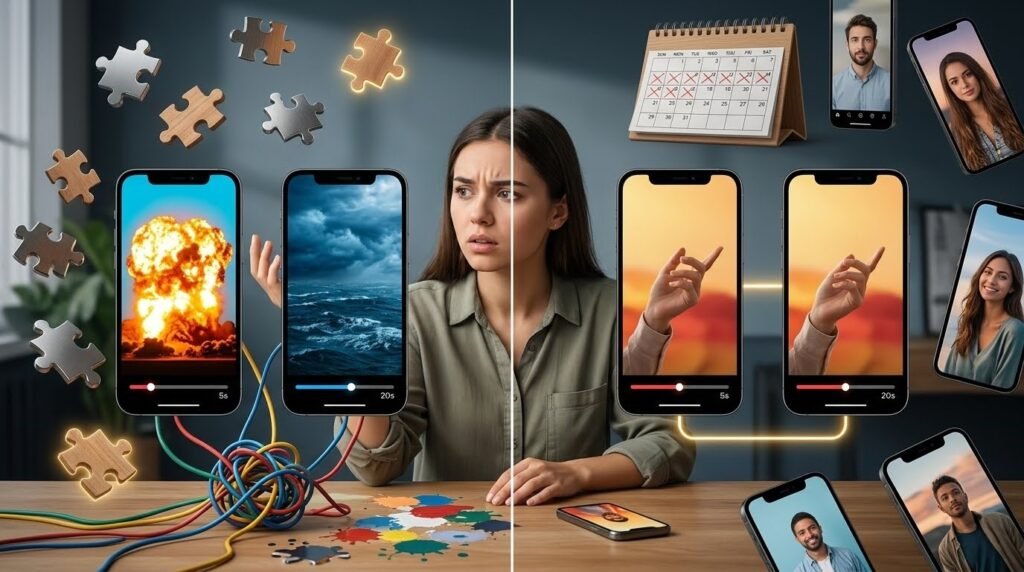
Using inconsistent captions or thumbnails across hook tests introduces variables that affect whether people click or stop on the video before the hook even plays. Keep everything outside the first five seconds identical across test versions.
Turning Test Results Into a Better Hook Library
Test results are only valuable if they get captured and used. A video that produced strong early retention with a specific hook style teaches something but only if that lesson gets recorded somewhere it can be referenced later.
Start by saving the opening clip from every video that produced measurably better early retention. Label it clearly: hook transition style, content niche, platform, approximate retention improvement. These clips form the beginning of a performance-based hook library that’s worth more than any pack of downloaded assets because it carries actual audience data behind it.
Organize saved clips by hook style first, then by niche. A suspense hook that worked for finance content might transfer to business content with minimal modification. A UGC reaction hook that worked for a skincare product might work for a supplement with the same emotional trigger. Niche organization makes that transfer obvious.
Identify patterns across successful hooks. If curiosity-based hooks consistently outperform pattern interrupts for a specific audience, that pattern is worth knowing. If UGC video hook clips consistently outperform polished transitional hooks for a specific type of product content, that’s an insight that should shape every future opening decision for that content category.
Adapt successful hook patterns rather than reusing the exact same clip repeatedly. The same clip used across too many videos starts to lose its pattern interrupt quality as it becomes familiar. The pattern, the structural approach, the hook style, the timing is what transfers. Fresh clips executing the same pattern maintain the effectiveness while keeping the visual fresh.
HookTransition.com provides a starting point for creators building this kind of organized, tested library reel hooks with no copyright concerns attached, transitional hooks, and short-form hook clips organized by type and ready to download for creators who want tested assets to pull from rather than building every opening from scratch.

Editing Tools To Overcome Trends
Chasing new editing trends produces inconsistent results because trends change faster than audiences do. What holds a specific audience through the first five seconds of a short-form video is more stable than whatever editing style is trending on a given week and testing reveals what that is for a specific creator’s specific audience, which is more valuable than any general advice about what hook transition are currently popular.
Every published video contains a data point about what that audience responded to. Treating those data points as disposable posting and moving on without capturing what the retention curve showed leaves the most useful information in content creation sitting unused.
Test the opening. Measure what happens. Build a library from what works. The algorithm responds to the same retention signals regardless of what’s trending. Fix the first five seconds and the distribution problem often fixes itself.


