Last updated: October 2026
On TikTok, Instagram Reels and YouTube Shorts, the first two seconds decide almost everything. If the opening does not give viewers a reason to stay, they swipe — and the platform takes that early drop-off as a signal to show your video to fewer people. A good hook is not a trick; it is a clear promise, delivered fast. This guide breaks down the types of hooks that work, how to build one step by step, and the mistakes that quietly kill retention.
What a hook actually has to do
A hook has two jobs. First, it has to interrupt the scroll — something on screen or in the audio has to be different enough from the last video that the viewer’s thumb pauses. Second, it has to create a reason to keep watching — a question the viewer wants answered, a result they want to see, or a story they want to finish. Most weak openers do only one of these. A loud sound with no promise gets a pause but not a watch; a great promise buried behind a slow intro never gets seen.
Seven hook types that work
1. The specific result
“I grew from 0 to 10k followers posting just three times a week.” A concrete number and outcome tells viewers exactly what they will get. Specificity is believable; vagueness is not.
2. The mistake
“Stop filming Reels with your phone’s 0.5 lens.” People are more motivated to avoid losses than to chase gains, so pointing out a common mistake works in almost every niche.
3. The question
“Why do some Reels get 100 views and others get 100,000?” A good question is one your viewer has already wondered about. Answer it quickly, or the hook turns into a bait-and-switch.
4. The visual interrupt
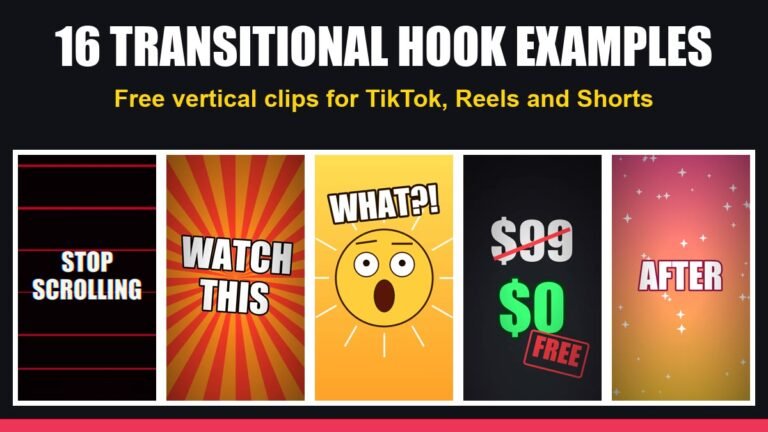
A sudden motion — a fall, a splash, a shocked face — in the first second. This is where transitional hook clips come in: a short burst of action, then a cut on the peak into your own footage.
5. The before-and-after
Show the finished result first, then rewind to the start. Transformations — rooms, recipes, edits, fitness — are natural fits.
6. The story opener
“My first brand deal paid me in socks.” Start in the middle of the story at its most surprising moment. Context can come later.
7. The direct callout
“If you edit in CapCut, you need this setting.” Naming your audience makes the right viewers feel the video is for them, and lets everyone else scroll on — which is fine.
How to build a hook in five steps
- Write down the single most valuable moment in your video. Your hook should point to it.
- Write five versions of your opening line using different hook types above. Do not judge them yet.
- Cut every word that is not doing work. “So today I want to show you how to…” becomes “Here’s how to…” — or better, just the result.
- Add a visual that matches the line. Text on screen, a fast cut, a reaction or a hook clip. The eyes and the ears should hit at the same time.
- Test it. Run your line through the Hook Analyzer, then post and check the retention graph in your analytics. If viewers drop off in the first two seconds, change the hook, not the whole video.
Common mistakes that kill retention
- Greeting first. “Hey guys, welcome back” spends your best two seconds on nothing.
- Logo or intro animation. Save branding for the end.
- Overpromising. A hook that the video does not deliver brings angry comments and lower watch time. Platforms notice.
- Text in the wrong place. On-screen hooks hidden behind the caption or buttons are invisible. Check them with the Safe Zone Checker.
- Too slow to say. If your spoken hook takes longer than about three seconds, shorten it.
- Reusing the same opener. Your regular viewers learn to skip it.
Hooks for different niches
- Education: lead with the mistake or the result. “This one Excel shortcut saves me an hour a week.”
- Food: open on the most satisfying shot — the cheese pull, the pour — then go back to the steps.
- Fitness: show the end position or the transformation first.
- Comedy and lifestyle: start mid-situation with a reaction.
- Product and business: open on the problem your audience feels, not on the product.
Measuring whether your hook worked
Every platform shows a retention graph. Look at the percentage of viewers still watching at the three-second mark. If it is well below your usual number, the hook did not work — even if the rest of the video is great. Change one thing at a time (line, visual or first shot) so you learn what made the difference. Over a few weeks you will see which hook types your audience responds to, and you can build a personal library of openers that work.
Quick checklist
- Does the first second contain movement or a clear visual change?
- Does the first line make a specific promise?
- Can the hook be understood with the sound off?
- Is the text inside the safe zone?
- Does the video actually deliver what the hook promised?
Next, learn how to turn a visual opener into a smooth cut in our guide to hook transitions, or browse free openers in the Hook Library.