Transitional Hooks: Free Hook Video Clips for TikTok & Shorts
Something nobody mentions when you first start running Transitional Hooks or posting short-form content the audience doesn’t owe you their attention. Not for a second. Not even half a second. Do the experiment yourself sometime. Open TikTok and just scroll without trying to watch anything deliberately. What you’ll notice if you actually pay attention to your own behavior rather than just the content is that you’re rarely making a conscious choice to skip. The video starts, something doesn’t immediately pull you in, and you’re already three videos past it before any real evaluation happens. It’s not a decision. It’s closer to a muscle memory that fires on its own.

Your content is competing against that reflex. Not against other creators, not against a distracted viewer who might come around if you give them a moment against something that doesn’t wait for your hook line to land.
Which is the whole reason transitional hooks exist, honestly. Not because someone invented a clever technique worth writing about. Because static openings genuinely cannot interrupt that reflex fast enough and movement can. A fast cut or a zoom that’s already happening when the video starts catches the eye before the thumb catches up, and that fraction of a second is the entire margin you’re working with on TikTok, Instagram Reels, and YouTube Shorts.
What Are Transitional Hooks and Why Do They Matter?
A regular hook is verbal. Something said or shown in the first few seconds that’s interesting enough to make someone stay. Most creators know this and most are doing some version of it: a bold claim, a question, a surprising statement. The problem is that words alone require the viewer to already be paying attention before they work. And on short-form platforms, that’s not a safe assumption to make.
A transitional hook adds a physical layer underneath the words. A fast cut, a zoom push, a whip pan, a smash edit timed to land at the same moment as the opening line so the video is already mid-motion before anyone consciously decides whether to watch. The line gives a reason to stay. The movement closes off the exit before anyone looks for it.

Traditional video intros are built around patience that short-form audiences simply don’t have anymore. Set context, introduce yourself, warm the viewer up that structure made sense when someone sat down intentionally to watch something. On Reels or Shorts, every second spent approaching the content is a second the viewer isn’t inside it yet. And not being inside it yet is skippable. Always.
Flip the order. Drop the viewer into something already moving, pair it with a visual cut that keeps momentum going, and the video is three seconds in before any real evaluation happens. Transitional Hooks is 3 seconds usually enough for the content to take over.
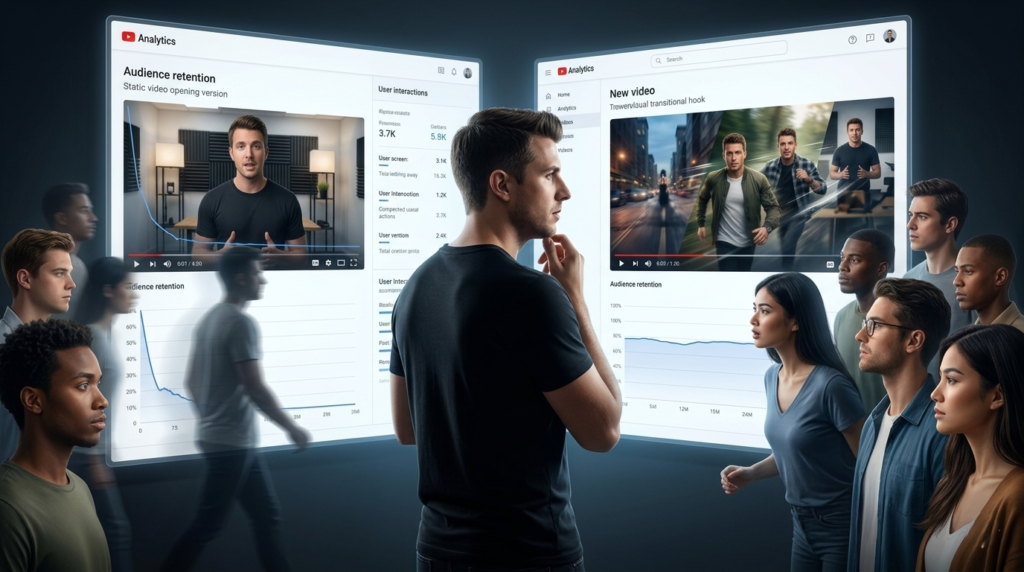
Audience retention data shows this pattern consistently across different niches and creators. Motion-based openings hold more viewers through the first five seconds than static openers delivering identical spoken content. Same words, same creator, same topic, different opening energy, measurably different retention curve. The opening isn’t a creative preference. It’s a technical variable with real numbers attached.
How Hook Video Clips Reduce Video Drop-Off Rate
Check the retention graph on any underperforming video and the shape is almost always the same. Steep drop right at the start, then the line flattens and holds reasonably well through the rest of the video. Which is a specific kind of frustrating because it means the content wasn’t the problem. The opening was. And the material never got seen because it never got a fair chance to be seen.
The video clips cut into that drop-off by removing the static pause that gives viewers an exit. When a video opens on a fast cut or a visual transition that’s already mid-energy, the eye starts tracking movement before any stay-or-leave decision gets made. That’s not a trick, it’s just how visual attention works, and short-form content that uses it from frame one is harder to scroll past than content sitting on a static frame waiting for something to happen.
Pattern interruption works alongside this. When something on screen doesn’t match the expected visual rhythm, a zoom hitting on an unexpected beat, an audio cut that doesn’t match the visual, a color shift that breaks the monotony of a plain talking-head opener the brain registers it as important before any conscious processing kicks in. That registration buys a second. Maybe two.
Two seconds sounds like nothing. It isn’t. Curiosity-driven openings stretch the window further. Start with something unresolved, a result without context, a statement that implies something went wrong, a visual that raises an obvious question and leaves you feeling uncomfortable in a way that’s hard to explain but easy to observe in your own scrolling behavior. The itch to find out what happens is more reliable than any perfectly crafted line, and it works on cold audiences who have no existing reason to care about the creator or the topic.
The Best Hooks for Short Form Video in 2026
Hook styles cycle in and out of trend but the ones that keep performing year after year are all pulling the same underlying levers. The format changes. Psychology doesn’t.
- The suspense cold open. No setup, no context, just dropped mid-tension into a moment where something is clearly at stake. Doesn’t require the viewer to care about the niche beforehand curiosity doesn’t need category familiarity to fire.
- The reaction open. Lead with a reaction of shock, disbelief, something clearly going wrong before showing what caused it. Emotional cues process faster than information does. Land the emotion first and the viewer wants the cause, which means watching.
- The reveal tease. Jump straight to the end result before any explanation of how it happened. Or show something partially blurred, cropped, cut off at the edge of frame that only makes sense if you keep watching. The open loop is genuinely difficult to leave without resolving.
- Zoom smash transition. Fast zoom into a hard cut right at the impact point. Reliable across content types, works layered on top of almost any other hook style, and one of the cleanest motion-based transitions specifically for vertical video.
- Text-first hook. Bold text hits the screen before any spoken audio. This matters more than most creators give it credit for a significant chunk of first impressions on most platforms happen with sound off. Text-first hooks reach those viewers immediately.
- The contrast cut. Two completely unrelated scenes smash-cut back to back right at the start. The visual mismatch forces the brain to pause and process, which interrupts the scroll reflex long enough to buy a few seconds.
- Motion blur cold open. Fast panning or intentional motion blur at the opening frame creates kinetic energy before a single word is delivered. Particularly effective as a cold open for product content and paid ads where the first impression needs to earn attention before the viewer registers what they’re looking at.
- The mid-sentence drop-in. Start already mid-thought, mid-sentence, as if the video has been running for thirty seconds. The viewer scrambles for context. Scrambling means watching.
- The before-and-after without the before. Show the after immediately no lead-up, no process, no explanation. The result lands first. The question of how follows automatically. How keeps people watching long enough for the content to justify the opening.
- The deliberate pattern interrupt. Something wrong, a sound that doesn’t fit, a visual that breaks the flow, a tonal shift that makes no immediate sense. Jarring on purpose. The disruption gets processed as significant before evaluation kicks in, which buys the involuntary attention that verbal hooks alone can’t reliably produce.

Using Transitional Hooks to Lower CPA in Video Ads
At some point this stops being a creator conversation and becomes a media buying conversation. CPA in video advertising traces back further than most buyers track it all the way to the opening frame of the ad.
Ad shown. Viewer watches or skips. Viewers who stay see the offer. Some percentage of those convert. Every point of failure in that chain inflates the cost of every conversion. And the point that fails most consistently, across accounts and categories and offer types, is the first two seconds.
Ad platforms charge for impressions regardless of what viewers did with them. An ad losing sixty percent of its audience in the first three seconds is still burning through budget. The impressions are real. The engagement isn’t, and the conversions reflect that. Running more spend against a weak hook doesn’t fix the funnel, it just scales the inefficiency.
Transitional hooks improve thumb-stop rate the percentage of viewers who actually pause when the ad appears. Higher thumb-stop means more viewers entering the consideration stage. More viewers in consideration means more conversions from the same spend without changing the offer, the landing page, or the targeting. Same budget, better creative opening, lower CPA. The relationship is direct.
Transitional Hooks styles that work in cold ad environments lean toward suspense and pattern interruption rather than humor. Funny hooks carry a precondition the viewer needs to already be open to laughing, which cold audiences scrolling past ads almost never are. Suspense and curiosity don’t need that precondition. They work on someone regardless of mood, which is why they consistently outperform comedy-led creative in paid environments even when the underlying offer is identical.
A short video transition for ads right at frame zero, even a half-second whip pan or a quick push-in before the main message begins signals movement before the viewer has identified it as an ad. By the time the ad concept registers, they’re already a few seconds in. That delay matters. It’s often the difference between a reflexive skip and an actual impression.
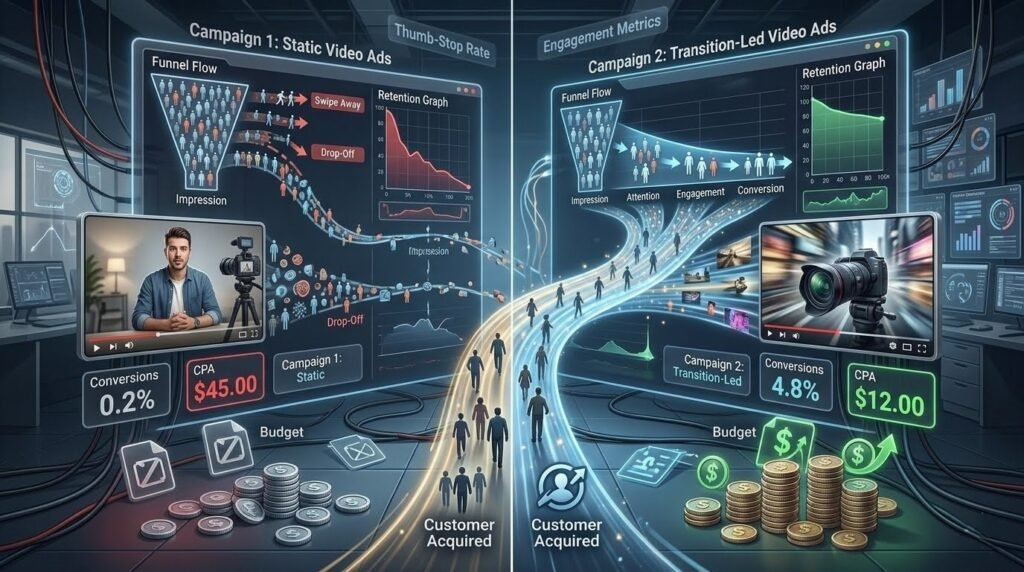
Media buyers who’ve run split tests on this consistently report meaningful thumb-stop differences between static openers and transition-led creative, even when the copy and offer stay the same. The hook is a performance variable. It has cost implications. Treating it as decoration on an otherwise complete ad is leaving real money on the table.
Best Video Editing Apps for Reels and Short-Form Content
The tool matters less than how you use it. That’s true and also slightly unhelpful for Transitional Hooks, so here’s the more practical version.
- CapCut is where most short-form creators start and honestly a lot of them never feel a strong reason to leave. It’s free, it’s built specifically for vertical video, and the speed ramping tool is useful enough for motion-based hook work that it justifies the whole app on its own. Ceiling is real, anything complex starts feeling cramped and the export quality at higher settings has historically been inconsistent. But for daily content at normal volume it covers the workflow without costing anything, which is hard to argue against.
- Adobe Premiere Pro is a different category of tool entirely. The timeline precision for syncing hook clips to specific audio moments, the control over exactly where a transition lands frame by frame mobile apps genuinely don’t replicate that. Plugin support adds transition options that don’t exist elsewhere. If the work involves client content, multiple accounts, or any kind of volume that requires consistency across edits, the subscription cost pays for itself in time saved. For casual personal posting it’s probably more than you need.
- DaVinci Resolve gets undermentioned relative to how capable it actually is. The free version handles most editing workflows without limitation, and the color grading tools are better than anything else available at zero cost which matters specifically when hooks rely on high-contrast visuals or dark suspense openers where color accuracy affects the impact of the clip. The learning curve is legitimately steep. Not something to try for the first time on a deadline.
- VN Editor sits in a gap that the other tools don’t quite fill. More timeline control than CapCut, significantly less overwhelming than Premiere on first open, handles multi-layer edits well enough for most transitional hook workflows without requiring a desktop setup. Worth trying if CapCut has started feeling limiting but committing to Premiere feels like too much of a jump.
- InShot is the speed option. Already have a cut video and need to drop a hook clip on the front and add a transition before posting? InShot handles that in a few minutes without reopening a full project. Not the right tool for anything requiring real precision, but for quick hook additions to existing content it’s genuinely fast.

Where to Download Free Hook Video Clips
Pexels and Pixabay are genuinely solid for what they were built for b-roll, establishing shots, background footage for long-form content. Wide, slow, cinematic. That aesthetic works well for a travel documentary. For something that needs enough kinetic energy to stop a scroll in under two seconds, that same aesthetic works against you. Searching either platform specifically for hook opener material usually means twenty minutes of irrelevant results before landing on one clip that might work with significant editing.
The licensing side is messier than most creators realize until it matters. Free for personal use and free for commercial advertising are not the same thing, and the line between them becomes very relevant the moment paid campaigns enter the picture. Pulling a clip that looked free and using it in a paid ad without checking the actual license terms is a problem that tends to surface at the worst possible time.
It was built around the specific gap those libraries leave. Not a general stock site with a hook section buried somewhere a library of hooks and hook video clips free to download, built from the ground up for short-form vertical content. Clips designed to function as video openers rather than repurposed footage from something else. Organized by hook type so the search process takes seconds rather than twenty minutes. Formatted for vertical platforms. Available without the copyright guesswork that comes with pulling from general stock and hoping for the best.
For anyone producing content at volume or running ads across multiple accounts, having that kind of pre-filtered library changes the asset-hunting part of the workflow completely. Pull the hook type that fits the content, drop it in, move on. The time that used to go toward finding something that almost works goes toward the actual edit instead.
Browse the library at HookTransition.com and download a few free hook clips to test. Drop one onto the opening of your next video or your next ad creative.


