Transitional Hooks for Videos Nobody Tells You About
Watch time dropping off at the same spot every time? Probably not your intro. Probably not your audio. Nine times out of ten, it’s the dead zone between your ideas. That 3-second gap where viewers decide to stay or scroll. Transitional hooks for videos fix exactly that. Not flashy edits. Not a better camera. Just the right words in the right place.
What Are Transitional Hooks for Videos?
They’re one or two sentences dropped right before you switch topics inside your video. That’s it. Nothing technical about it.
The goal isn’t to summarize what you just said. That signals, chapter closed to the brain, and viewers peace out. The goal is to make the next part of your video feel too important to miss before they even get there.
Bad transition: “So that covers point one, let’s move to point two.”
Good transition: “That part’s simple. What breaks most people is what comes next.”
Same information. Completely different effect on the viewer.
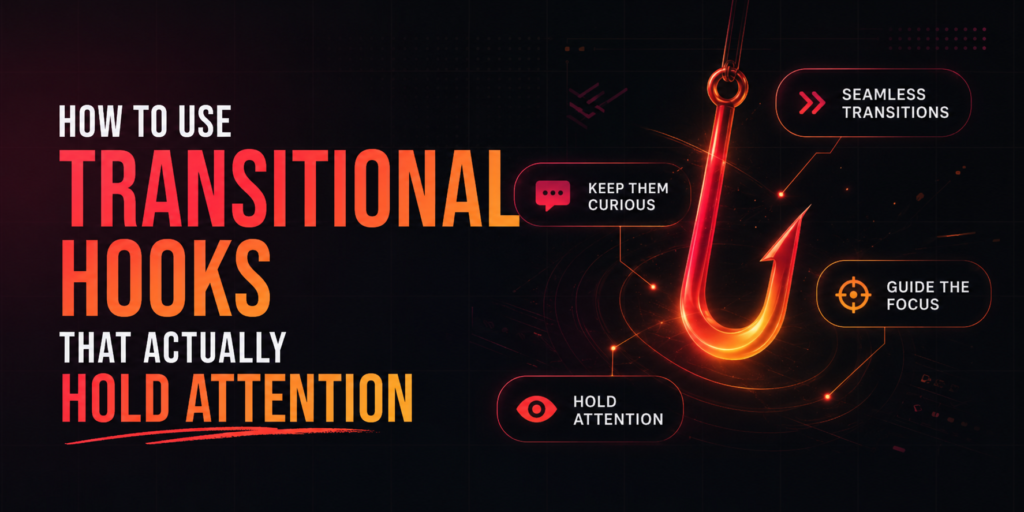
How to Use Transitional Hooks That Actually Hold Attention
Open a loop, close it later
Ask a question mid-video that you don’t answer for another 60 seconds. Something like: “Here’s where I made a mistake that cost me three months. I’ll show you in a second.”
Unresolved questions are genuinely uncomfortable for the brain. People stick around just to get the answer. Screenwriters have used this forever. It translates perfectly to YouTube, Reels, anywhere.
Skip the recap, tease what’s ahead
Recapping kills pace. Every creator does it without realizing “Okay so now that we’ve established X…” is an exit ramp, not a bridge. Ditch it. Point forward instead, and make forward sound worth it.
Change your physical energy on camera
Lower your voice. Lean in. Pause for a second longer than feels normal. These subtle shifts cue the viewer that something is about to matter. Works in raw talking-head footage with zero editing.
Do Transitional Hooks Work Differently on Short-Form?
They work harder on short-form, because you have less goodwill to spend.
On TikTok or Reels, there’s no patience buffer. Viewers aren’t giving you “another 30 seconds.” According to HubSpot’s video marketing research, platforms weight retention signals heavily when deciding how widely to distribute content. That means every second someone stays is actively helping your reach.
Social media marketers especially should treat transitional hooks as a scripting standard, not an optional layer. It’s one of few things that improves performance without touching budget or production quality.
Real Examples for Different Creator Types
Tutorial creators: Step two is straightforward. Step three is where I see people waste weeks.
Product reviewers: I went in ready to recommend this. Changed my mind pretty quickly.
Coaches or educators: Everything so far builds to this one point. Don’t skip it.
Brand content on Reels: Watch what happens when we try this.
If you want to study real examples, not theory across different niches and styles, this viral transitional hook library is a solid starting point. Seeing them in actual videos is worth more than any framework.
Is There Such a Thing as Too Many Transitional Hooks?
Absolutely. Use them at every cut and your video starts feeling like a series of fake cliffhangers. Viewers notice. Two or three per video, at the moments where drop-off typically spikes after your first main point, before your final section is plenty.
Conclusion
Retention doesn’t improve by accident. Transitional hooks for videos are one of the most underused tools available to creators — and learning how to use transitional hooks costs nothing except a bit of intentional scripting. Build them into your process before you hit record. Your watch time will tell you whether it’s working.


